Private colleges in California · By CalChannel Editorial Team · Updated October 5, 2026
The Stanford acceptance rate was 3.8% for Fall 2025: Stanford admitted 2,302 of 60,646 first-year applicants, according to its Common Data Set. It’s a private university in Stanford, California, next to Palo Alto. The 2026-27 student budget is $97,545, but families earning under $150,000 with typical assets pay no tuition, and those under $100,000 pay no tuition, housing or food.
Stanford University is one of the most selective and best-known universities in the world, and it sits in the middle of Silicon Valley. It’s private, not part of the UC or CSU systems, and it has its own admission process and its own need-based financial aid.
Stanford is the hardest university in California to get into and, for many families, one of the most affordable. This guide uses Stanford’s 2025-26 Common Data Set and its 2026-27 student budget to show both sides: how few applicants get in through each route, and what families at different incomes actually pay.
| Fact | Stanford University |
|---|---|
| Official name | Leland Stanford Junior University |
| Type | Private research university (not UC or CSU) |
| Location | Stanford, California, next to Palo Alto in Santa Clara County |
| Founded | 1885 (opened 1891) |
| Acceptance rate | 3.8% (Fall 2025: 2,302 admitted of 60,646 applicants) |
| SAT/ACT | Required again starting with Fall 2026 applicants; middle 50% SAT 1520-1570, ACT 34-36 (Fall 2025) |
| Students | 18,121 total, 7,346 undergraduates (Fall 2025) |
| Tuition (2026-27) | $67,731 |
| Student budget (2026-27) | $97,545 before aid |
| Tuition-free threshold | Family income under $150,000 with typical assets |
| Retention / graduation rate | 97% / 92% in six years (2019 cohort) |
| Student-to-faculty ratio | 10:1 |
| Calendar | Quarter system |
| Athletics | Cardinal, NCAA Division I, Atlantic Coast Conference |
Sources: Stanford Common Data Set 2025-26; Stanford Financial Aid Office, The Student Budget 2026-27; Stanford Undergraduate Admission. Full list at the end of the article.
In This Article
- Stanford in Brief: History and Schools
- Where Is Stanford University Located?
- Is Stanford Public or Private?
- Stanford Acceptance Rate and Transfer Odds
- What Stanford Looks For: Tests, Essays and Early Action
- Stanford Cost and Who Pays Nothing
- Stanford’s Graduate-Heavy Campus and Graduation Rates
- Silicon Valley, Startups and ACC Athletics
- Frequently Asked Questions
Stanford in Brief: History and Schools
Stanford University, officially Leland Stanford Junior University, is a private research university founded in 1885 by Leland and Jane Stanford in memory of their son. It opened to students in 1891. Undergraduates study in the School of Humanities and Sciences, the School of Engineering or the Doerr School of Sustainability, and the university also includes schools of business, education, law and medicine.
Stanford University runs on the quarter system, with autumn, winter and spring quarters. Undergraduates apply to the university as a whole rather than to a specific major, and they declare a major later.

Where Is Stanford University Located?
Stanford is in Stanford, California, an unincorporated community in Santa Clara County next to the city of Palo Alto. It’s in the heart of Silicon Valley, about 35 miles southeast of San Francisco and about 20 miles northwest of San Jose. If you’re searching for the city and state, the short answer is Stanford (Palo Alto area), California.
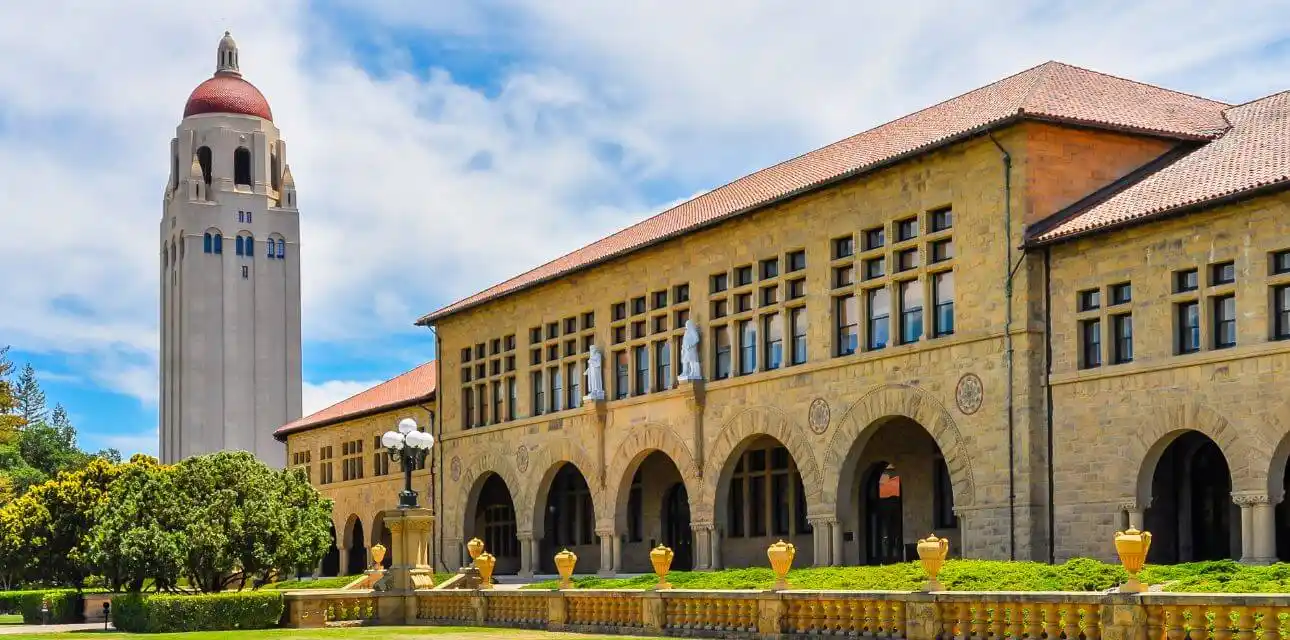
The campus is one of the largest in the country, spreading across more than 8,000 acres of land that includes the Main Quad, Memorial Church, Hoover Tower and open foothills with the “Dish” radio telescope. Caltrain’s Palo Alto station and free Marguerite shuttles connect the campus to the rest of the Bay Area.
Is Stanford Public or Private?
Stanford is private. It’s governed by an independent Board of Trustees and is not part of the University of California or California State University systems. It sets its own tuition, which is the same for California residents and out-of-state students.
In California, Stanford is usually compared with Caltech and USC among private universities, and with UC Berkeley and UCLA among public ones.
Stanford Acceptance Rate and Transfer Odds
Stanford admitted 3.8% of first-year applicants for Fall 2025: 60,646 students applied, 2,302 were admitted and 1,839 enrolled, according to its Common Data Set 2025-26. That makes Stanford one of the most selective universities in the United States.
| Stanford, Fall 2025 | Number |
|---|---|
| First-year applicants | 60,646 |
| Admitted | 2,302 (3.8%) |
| Enrolled | 1,839 |
| Offered a place on the waitlist | 669 |
| Accepted a waitlist place | 573 |
| Admitted from the waitlist | 57 |
Source: Stanford Common Data Set 2025-26, items C1 and C2.
About 80% of admitted students enrolled, one of the highest yields in the country. Among those who reported class rank, 97% were in the top tenth of their high school class.
Can You Transfer to Stanford?
Yes, but transfer admission is even more selective than first-year admission. For Fall 2025, Stanford admitted 102 of 4,532 transfer applicants, about 2.3%, and 89 enrolled. Students at community colleges and other universities shouldn’t plan on transferring to Stanford; treat it as a long shot alongside UC transfer options.
What Stanford Looks For: Tests, Essays and Early Action
Stanford University uses holistic review, looking at academic excellence, intellectual vitality, personal context and character through grades, course rigor, essays, recommendations and activities. Almost every applicant is academically strong, so the essays and recommendations carry real weight.
- Application: the Common Application, with Stanford’s short-answer questions and essays; Stanford’s CDS lists a $100 application fee, with fee waivers available
- Testing: Stanford reinstated its SAT or ACT requirement starting with applicants for Fall 2026 entry
- Scores: the middle 50% of Fall 2025 first-years scored 1520-1570 on the SAT and 34-36 on the ACT
- Restrictive Early Action: apply by November 1 and hear by mid-December; it’s nonbinding, but you generally can’t apply early to other private colleges at the same time
- Regular Decision: the deadline is in early January
So what does that mean in practice? With a 3.8% admit rate, Stanford is a reach for every applicant. Build a balanced list that includes UC campuses and other private California colleges.
Stanford Cost and Who Pays Nothing
Stanford’s 2026-27 undergraduate student budget is $97,545 before financial aid. Tuition is $67,731, unchanged from 2025-26 after the Board of Trustees held tuition steady, while standard housing and food rose 3.5% to $22,944.
| Stanford student budget | 2026-27 |
|---|---|
| Tuition | $67,731 |
| Housing and food | $22,944 |
| Student fees allowance | $2,610 |
| Books and supplies allowance | $855 |
| Personal expenses allowance | $3,405 |
| Travel | Varies |
| Total | $97,545 |
Source: Stanford Financial Aid Office, The Student Budget, 2026-27. New students also pay a one-time $525 orientation fee and a $250 document fee.
Most students don’t pay that full price. Stanford meets full demonstrated need and does not expect students to borrow to meet it. Families earning less than $150,000 with typical assets pay no tuition, and families earning less than $100,000 pay no tuition, housing or food. Almost half of undergraduates receive need-based aid, and the average need-based scholarship and grant award for first-year aid recipients in Fall 2025 was $72,166, according to Stanford’s Common Data Set.
Our take: For many California families, Stanford can cost less than a UC campus. A family earning $120,000 with typical assets owes no tuition at Stanford, and the aid covers much of the remaining budget. Don’t rule Stanford out on sticker price; run its net price calculator and compare the result with your UC and Cal Grant estimates.
Stanford’s Graduate-Heavy Campus and Graduation Rates
Stanford University had 18,121 students in Fall 2025: 7,346 undergraduates and 10,775 graduate students, according to its Common Data Set. Undergraduates are a minority on campus, but the student-to-faculty ratio is 10:1 and most classes are small.
Nearly all students stay and finish. About 97% of first-year students returned for their second year, and 92% of the 2019 entering class graduated within six years. Stanford guarantees on-campus housing for four years for undergraduates.
Silicon Valley, Startups and ACC Athletics
Stanford University is known for computer science, engineering, the sciences, economics and entrepreneurship, and for its deep ties to Silicon Valley. Companies such as Google, Hewlett-Packard, Yahoo and Nvidia were founded or co-founded by Stanford students or alumni, and the Graduate School of Business, the School of Medicine and the Law School are among the most prominent in the country.
The Stanford Cardinal compete in NCAA Division I and joined the Atlantic Coast Conference in 2024. Stanford athletes have won more NCAA team championships than those of almost any other university, and its annual Big Game against UC Berkeley is one of the oldest rivalries in the West.
Frequently Asked Questions
What is the Stanford acceptance rate?
Stanford admitted 3.8% of first-year applicants for Fall 2025, or 2,302 of 60,646, according to its Common Data Set 2025-26.
Where is Stanford University located, city and state?
Stanford is in Stanford, California, an unincorporated community in Santa Clara County next to Palo Alto, about 35 miles southeast of San Francisco.
Is Stanford public or private?
Stanford is a private university. It is not part of the University of California or California State University systems, and tuition is the same for California and out-of-state students.
How much does Stanford cost per year?
Stanford’s 2026-27 student budget is $97,545, including $67,731 in tuition and $22,944 for housing and food. Families earning under $150,000 with typical assets pay no tuition.
Does Stanford require the SAT or ACT?
Yes. Stanford reinstated its SAT or ACT requirement starting with applicants for Fall 2026 entry.
Does Stanford accept transfer students?
Yes, but very few. Stanford admitted 102 of 4,532 transfer applicants for Fall 2025, about 2.3%.
What state is Stanford University in?
Stanford is in California, in the San Francisco Bay Area’s Silicon Valley region.
Should You Apply to Stanford?
Stanford University is a private research university next to Palo Alto, California, with 7,346 undergraduates. It requires the SAT or ACT again, offers a nonbinding Restrictive Early Action round with a November 1 deadline, and graduates 92% of students within six years. Compare Stanford with Santa Clara University, University of the Pacific and other private colleges in California.
Its 2026-27 budget is $97,545 before aid, but families earning under $150,000 pay no tuition and those under $100,000 pay no tuition, housing or food. If Stanford is on your list, run the net price calculator early and apply to a balanced mix of UC, CSU and private California colleges.
Sources
- Stanford Institutional Research and Decision Support. “Common Data Set 2025-26.” stanford.edu.
- Stanford Financial Aid Office. “The Student Budget.” stanford.edu.
- Stanford Report. “Stanford holds undergraduate tuition steady for 2026-27.” stanford.edu.
- Stanford Undergraduate Admission. “Afford.” stanford.edu.
- Wikipedia. “Stanford University.” Wikipedia.org.

CalChannel Editorial Team California college guides
The CalChannel editorial team researches and writes guides to California colleges, admissions and financial aid. We build our college profiles and aid guides from colleges’ own published data, federal IPEDS data and the California Student Aid Commission. Read our editorial policy.