Private colleges in California · By CalChannel Editorial Team · Updated October 5, 2026
University of the Pacific admitted 69.1% of first-year applicants for Fall 2025, or 5,977 of 8,656, according to its Common Data Set. Pacific is a private university based in Stockton, with professional schools in Sacramento and San Francisco. Full-time undergraduate tuition for 2026-27 is $29,780 per semester, or $59,560 a year, plus campus fees.
University of the Pacific, often called UOP or simply Pacific, was the first chartered university in California. It’s best known for health sciences, including accelerated pharmacy and dental pathways, along with engineering, business and music.
Pacific is a different kind of private university: a small Stockton campus feeding into professional schools in Sacramento and San Francisco. This guide covers who gets in, what a year really costs with housing, and how the accelerated health pathways change the math, using Pacific’s 2025-26 Common Data Set and its 2026-27 rates.
| Fact | University of the Pacific |
|---|---|
| Type | Private university |
| Campuses | Stockton (main undergraduate campus), Sacramento and San Francisco |
| Founded | 1851 |
| Acceptance rate | 69.1% (Fall 2025: 5,977 admitted of 8,656 applicants) |
| Acceptance rate, California residents | 75.7% (Fall 2025: 4,405 of 5,818) |
| Average high school GPA | 3.61 (Fall 2025 enrolled first-years) |
| SAT/ACT | Test-optional; middle 50% SAT 1220-1453, ACT 26-34 for those who submitted |
| Students | 6,852 total, 3,097 undergraduates (Fall 2025) |
| Tuition (2026-27) | $29,780 per semester ($59,560 a year) for 12-18 units |
| Retention / graduation rate | 85% / 72% in six years (2019 cohort) |
| Student-to-faculty ratio | 12:1 |
| Athletics | Tigers, NCAA Division I, West Coast Conference |
Sources: University of the Pacific Common Data Set 2025-26; Pacific Financial Aid, Undergraduate Tuition and Fees 2026-27. Full list at the end of the article.
In This Article
- Pacific in Brief: California’s First Chartered University
- Pacific Acceptance Rate for California and Out-of-State Students
- Applying to Pacific: Early Action and Accelerated Programs
- Pacific Tuition, Fees and Cost With Housing
- How Big Is Pacific, and Do Students Finish?
- Stockton, Sacramento and San Francisco: Why Three Campuses
- Frequently Asked Questions
Pacific in Brief: California’s First Chartered University
University of the Pacific is a private university founded in 1851, making it the first chartered university in California. Its undergraduate programs are based in Stockton and include the College of the Pacific (arts and sciences), the Eberhardt School of Business, the School of Engineering and Computer Science, the Conservatory of Music, and the Thomas J. Long School of Pharmacy and other health sciences programs.
Pacific is known for accelerated pathways that let students move quickly from undergraduate study into professional degrees in pharmacy, dentistry and law. It is not the same school as Pacific University, a separate private university in Oregon.
Pacific Acceptance Rate for California and Out-of-State Students
University of the Pacific admitted 69.1% of first-year applicants for Fall 2025: 8,656 students applied, 5,977 were admitted and 676 enrolled, according to its Common Data Set 2025-26.
| Pacific, Fall 2025 | Applied | Admitted | Acceptance rate | Enrolled |
|---|---|---|---|---|
| First-year, California residents | 5,818 | 4,405 | 75.7% | 565 |
| First-year, out-of-state | 2,421 | 1,285 | 53.1% | 64 |
| First-year, international | 348 | 242 | 69.5% | 43 |
| All first-year applicants | 8,656 | 5,977 | 69.1% | 676 |
| Transfer applicants | 719 | 565 | 78.6% | 252 |
Source: University of the Pacific Common Data Set 2025-26, items C1, C2 and D2. Residency rows exclude applicants of unknown residency.
Accelerated health programs, such as the pre-pharmacy and pre-dental pathways, are more competitive than the university average.
Applying to Pacific: Early Action and Accelerated Programs
Pacific reviews grades, course rigor, essays and activities. Enrolled first-years for Fall 2025 averaged a 3.61 high school GPA.
- Application: the Common Application; Pacific’s CDS lists a $55 application fee, with waivers available
- Testing: test-optional; the middle 50% of Fall 2025 submitters scored 1220-1453 on the SAT and 26-34 on the ACT
- Early Action: Pacific’s Common Data Set lists a nonbinding Early Action deadline of November 15, with decisions by December 20
- Programs: accelerated pharmacy, dental and law pathways have additional requirements and limited seats
- Waitlist: for Fall 2025, 200 students accepted a waitlist spot and 172 were admitted from it
- Transfers: Pacific admitted 565 of 719 transfer applicants for Fall 2025
Pacific Tuition, Fees and Cost With Housing
For 2026-27, full-time undergraduate tuition at Pacific’s Stockton campus is $29,780 per semester for 12 to 18 units, or $59,560 for the year. Full-time students also pay per-semester campus fees, including a $300 wellness center fee, a $150 student activity fee and a $150 activity and recreation fee, plus program fees in some schools. Students without comparable coverage are charged $1,984 per semester for student health insurance.
| Pacific tuition and required fees, 2026-27 (Stockton) | Per semester | Per year |
|---|---|---|
| Tuition (12-18 units) | $29,780 | $59,560 |
| Wellness center fee | $300 | $600 |
| ASUOP student activity fee | $150 | $300 |
| Activity and recreation fee | $150 | $300 |
| Total tuition and campus fees | $30,380 | $60,760 |
| Student health insurance (can be waived) | $1,984 | $3,968 |
Source: University of the Pacific, Undergraduate Tuition and Fees, Fall 2026 and Spring 2027. Housing, food, books and personal costs are additional. Engineering and business students pay small school fees, and new students pay a one-time $100 matriculation fee.
Housing and food add the most on top of tuition. In Pacific’s 2026-27 budget for a full-time undergraduate living on campus, housing is $9,876 and food is $7,900, bringing estimated direct costs to $78,536 a year before books, transportation and personal expenses.
Many Pacific students receive grant or scholarship aid, and California residents can use a Cal Grant at Pacific. Use Pacific’s net price calculator to estimate your full cost with housing and aid included.
Our take: Pacific’s accelerated programs can save a year or more of tuition on the way to a professional degree. For students set on pharmacy or dentistry, the shorter timeline can matter as much as the annual sticker price.
How Big Is Pacific, and Do Students Finish?
Pacific had 6,852 students in Fall 2025, including 3,097 undergraduates and 3,755 graduate and professional students, according to its Common Data Set. The student-to-faculty ratio is 12:1.
About 85% of first-year students returned for their second year. Of the 2019 entering class, 53% graduated in four years and 72% within six years.
Stockton, Sacramento and San Francisco: Why Three Campuses
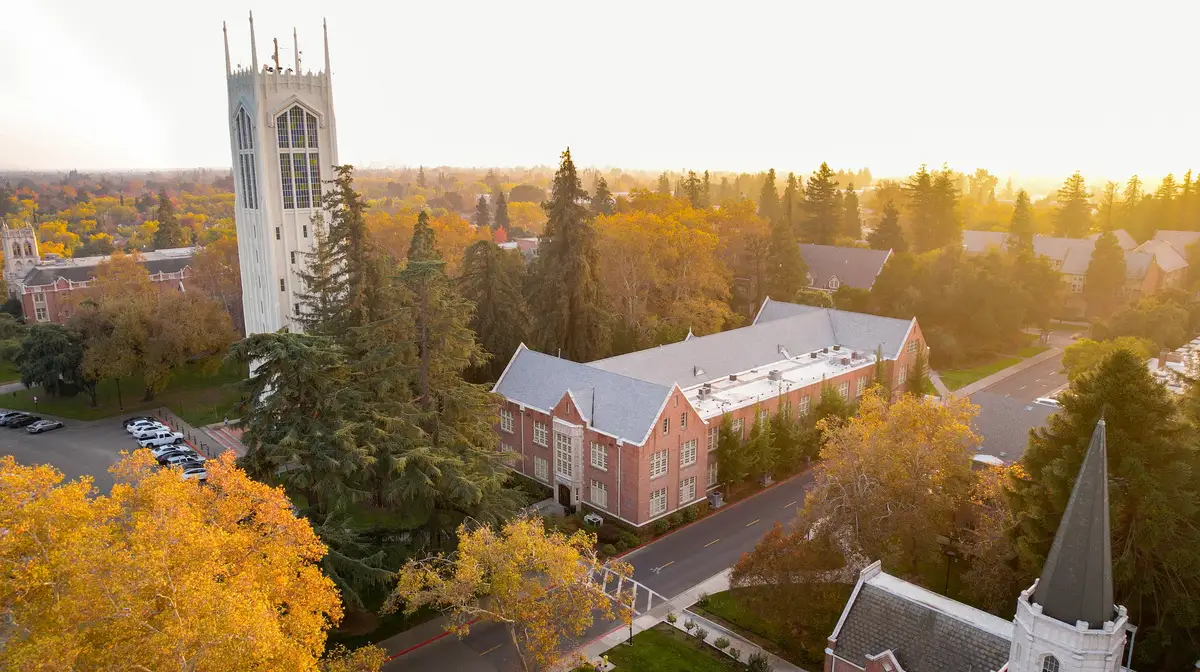
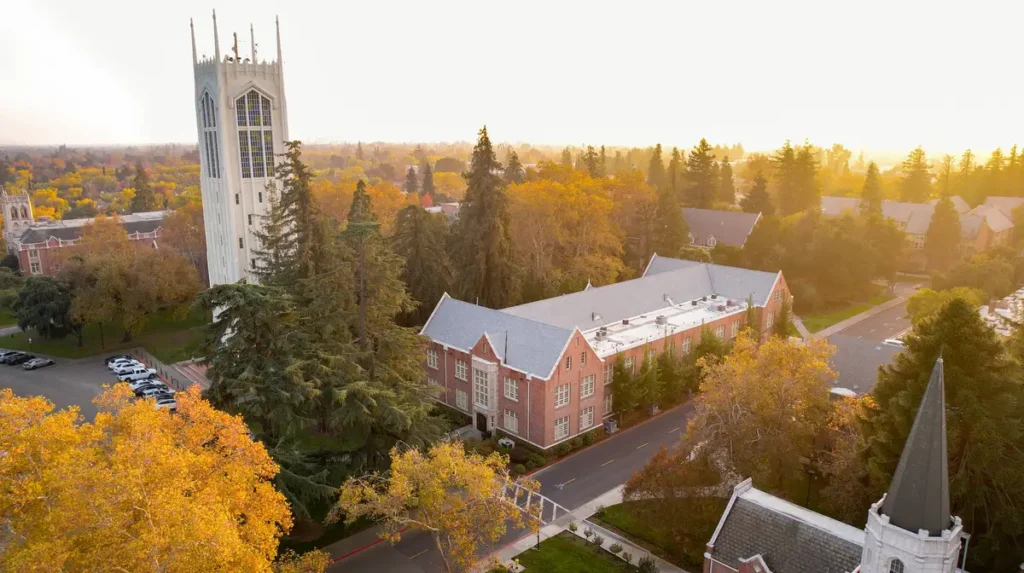
Pacific’s main undergraduate campus is in Stockton, in California’s Central Valley, about 80 miles east of San Francisco. The tree-lined Stockton campus, with its red-brick buildings and Burns Tower, is often compared to an East Coast college campus.
Why does UOP have campuses in three cities? Its Arthur A. Dugoni School of Dentistry is in San Francisco, and its McGeorge School of Law is in Sacramento, alongside graduate programs in health, business and public policy. That structure gives undergraduates pathways into professional schools in major California cities. The Pacific Tigers compete in NCAA Division I in the West Coast Conference.
Frequently Asked Questions
What is the University of the Pacific acceptance rate?
Pacific admitted 69.1% of first-year applicants for Fall 2025, or 5,977 of 8,656, according to its Common Data Set.
Is University of the Pacific the same as Pacific University in Oregon?
No. University of the Pacific is a private university based in Stockton, California. Pacific University is a separate private university in Forest Grove, Oregon.
How much is tuition at University of the Pacific?
For 2026-27, full-time undergraduate tuition at the Stockton campus is $29,780 per semester, or $59,560 a year, plus campus fees.
How much does it cost to live on campus at Pacific?
For 2026-27, Pacific estimates direct costs of $78,536 for a full-time undergraduate living on campus, including $59,560 in tuition, $1,200 in fees, $9,876 for housing and $7,900 for food.
Is UOP a good choice for health sciences?
For many students, yes. Pacific is known for its pharmacy school and accelerated pathways into pharmacy and dentistry, which can shorten the time to a professional degree.
How many students attend University of the Pacific?
Pacific enrolled 6,852 students in Fall 2025, including 3,097 undergraduates.
Is Pacific a Good Fit?
University of the Pacific is a private university in Stockton. It’s known for health sciences, accelerated professional pathways and small classes, with a 12:1 student-to-faculty ratio.
Tuition for 2026-27 is $59,560 a year before aid. Compare Pacific with Santa Clara University, the University of San Francisco, Chapman University and other private colleges in California.
Sources
- University of the Pacific Institutional Research. “Common Data Set 2025-26.” pacific.edu.
- University of the Pacific. “Undergraduate Tuition and Fees.” pacific.edu.
- University of the Pacific Financial Aid. “Undergraduate Cost of Attendance.” pacific.edu.
- Wikipedia. “University of the Pacific.” Wikipedia.org.

CalChannel Editorial Team California college guides
The CalChannel editorial team researches and writes guides to California colleges, admissions and financial aid. We build our college profiles and aid guides from colleges’ own published data, federal IPEDS data and the California Student Aid Commission. Read our editorial policy.