University of California guide · By CalChannel Editorial Team · Updated September 30, 2026
The UC Santa Barbara acceptance rate was 44.0% for first-year applicants in Fall 2026, or 47,716 of 108,512, according to the University of California. That’s up from 38.2% for Fall 2025, when California residents were admitted at 32.1%. The middle 50% of Fall 2026 admits had a 4.05 to 4.27 high school GPA. For 2026-27, a California resident living in a residence hall should budget $50,946.
UC Santa Barbara, or UCSB, is the University of California’s beachfront campus on the coast west of Santa Barbara. People search for it for three reasons: to see whether they can get in, to find out what it costs, and to understand how big it is. This guide answers all three with the newest official numbers, then explains what the campus, housing and academics are really like.
| Fact | UC Santa Barbara |
|---|---|
| First-year admit rate, Fall 2026 | 44.0% (47,716 of 108,512) |
| First-year admit rate, Fall 2025 | 38.2% overall; 32.1% for California residents |
| Transfer admit rate, Fall 2026 | 61.6% (11,620 of 18,870) |
| GPA of admitted first-years, Fall 2026 (middle 50%) | 4.05 to 4.27 |
| Students, Fall 2025 | 26,035 total; 23,091 undergraduates |
| In-state cost of attendance, residence hall (2026-27) | $50,946 |
| Out-of-state cost of attendance, residence hall (2026-27) | $90,216 |
| U.S. News 2027 | No. 44 National Universities; No. 14 public |
| Six-year graduation rate | 84% (2019 cohort) |
Sources: University of California, UC Santa Barbara first-year and transfer admit data for Fall 2026; UC Santa Barbara Common Data Set 2025-26; UCSB Office of Financial Aid and Scholarships. Full list at the end of the article.
In This Article
UC Santa Barbara Acceptance Rate
The UC Santa Barbara acceptance rate was 44.0% for first-year applicants in Fall 2026: 108,512 students applied and 47,716 were admitted, according to admit data published by the University of California. A year earlier, UCSB admitted 38.2%, or 42,093 of 110,187, according to its Common Data Set 2025-26.
So the UC Santa Barbara acceptance rate went up for Fall 2026, and UCSB got somewhat easier to get into. Applications dipped slightly, and the campus admitted about 5,600 more students. That doesn’t mean the bar dropped. The middle half of Fall 2026 admits still had high school GPAs between 4.05 and 4.27, so UCSB remains a campus for students with top grades in a demanding schedule.
| First-year admission | Applicants | Admits | Admit rate |
|---|---|---|---|
| Fall 2026 | 108,512 | 47,716 | 44.0% |
| Fall 2025 | 110,187 | 42,093 | 38.2% |
Sources: University of California, UC Santa Barbara first-year admit data (Fall 2026); UC Santa Barbara Common Data Set 2025-26 (Fall 2025). The two sources count applicants slightly differently.
UCSB also uses its waitlist heavily. For Fall 2025, 18,022 students accepted a place on the waitlist and 9,603 were admitted from it. If UCSB waitlists you, accept the spot and keep your options open.
UCSB Acceptance Rate: In-State vs. Out-of-State
For California residents, the UC Santa Barbara acceptance rate is lower than the overall figure suggests. In Fall 2025, UCSB admitted 32.1% of California applicants, compared with 54.5% of out-of-state applicants and 47.6% of international applicants. The UC’s Fall 2026 snapshot doesn’t break admits down by residency yet, so the Fall 2025 figures are the latest available.
| Fall 2025 first-years | Applied | Admitted | Admit rate | Enrolled |
|---|---|---|---|---|
| California residents | 74,486 | 23,923 | 32.1% | 3,770 |
| Out-of-state | 17,067 | 9,302 | 54.5% | 701 |
| International | 18,634 | 8,868 | 47.6% | 610 |
| All first-years | 110,187 | 42,093 | 38.2% | 5,081 |
Source: UC Santa Barbara Common Data Set 2025-26. In-state and out-of-state status reflects the address applicants gave on the application.
Why the gap? UC campuses admit more nonresidents because many of them don’t enroll. Only 701 of the 9,302 out-of-state admits enrolled at UCSB in Fall 2025, about 8%, compared with about 16% of California admits. The price difference explains most of it: nonresidents pay $39,270 more each year.
What GPA Do You Need for UCSB?
The UC minimum is a 3.0 GPA in A-G courses for California residents and 3.4 for nonresidents, but that’s only eligibility. The middle 50% of UCSB’s Fall 2026 admits had weighted high school GPAs of 4.05 to 4.27. Among first-years who enrolled in Fall 2025, the average weighted GPA was 4.29, and about 88% had a 4.0 or higher.
A GPA in that range doesn’t guarantee admission, and a lower one doesn’t rule it out. UCSB reads each application holistically, looking at course rigor, the Personal Insight Questions and your circumstances alongside grades. Test scores play no role, because UC campuses don’t consider the SAT or ACT.
- Application: the UC application; $80 per campus for U.S. residents and $95 for international applicants, with fee waivers available
- Deadline: November 30; there is no early action or early decision
- Colleges: you apply to the College of Letters and Science, the College of Engineering or the small College of Creative Studies
UCSB Transfer Admission
The UC Santa Barbara acceptance rate for transfer applicants is much higher. UCSB admitted 61.6% of transfer applicants for Fall 2026, or 11,620 of 18,870, and 92.2% of admitted transfers came from California community colleges. For Fall 2025, the transfer admit rate was 59.0%.
UCSB also takes part in the UC Transfer Admission Guarantee (TAG), which guarantees admission to eligible California community college students who meet its GPA and course requirements. If you live on the Central Coast, Santa Barbara City College is one of the best-known local starting points, and our guide to California community colleges covers other options.
UCSB Tuition and Cost
For 2026-27, UCSB in-state tuition is $15,588 in systemwide tuition and fees for new students, plus $2,085 in campus-based fees. The full cost of attendance for a California resident living in a residence hall is $50,946. Out-of-state students add $39,270 in Nonresident Supplemental Tuition, for a total of $90,216.
| UCSB cost of attendance, 2026-27 (residence halls) | California residents | Nonresidents |
|---|---|---|
| Tuition and student services fee | $15,588 | $15,588 |
| Nonresident supplemental tuition | — | $39,270 |
| Campus-based fees | $2,085 | $2,085 |
| Rent | $13,203 | $13,203 |
| Food | $10,782 | $10,782 |
| Books and supplies | $1,515 | $1,515 |
| Health care allowance | $4,008 | $4,008 |
| Personal, phone and transportation | $3,765 | $3,765 |
| Total | $50,946 | $90,216 |
Source: UCSB Office of Financial Aid and Scholarships, Undergraduate Cost of Attendance Budget, 2026-27, University Housing residence halls.
So how much is UCSB, really? Tuition is the same at every UC campus. What makes UCSB one of the pricier UCs is living cost: the residence hall budget includes nearly $11,000 for food and more than $13,000 for rent. For California families, aid closes much of that gap. Under UC’s Blue and Gold Opportunity Plan, most California families earning up to $100,000 receive enough grant and scholarship aid to cover UC tuition, and Cal Grants, Pell Grants and the Middle Class Scholarship can help with living costs. Our UC tuition guide compares costs across campuses.
UCSB Student Population
UC Santa Barbara had 26,035 students in Fall 2025: 23,091 undergraduates and 2,944 graduate students, according to its Common Data Set. That makes UCSB a mid-sized UC with an unusually strong undergraduate focus. About nine in ten of its students are undergraduates.
The student body is also notably diverse. In 2015, UCSB became the first member of the Association of American Universities to be designated a Hispanic-Serving Institution, a designation for colleges where at least 25% of full-time undergraduates are Hispanic. The student-to-faculty ratio is 18:1, about 93% of first-years return for a second year, and 84% of the 2019 entering class graduated within six years, including 71% in four.
Campus, Housing and Isla Vista
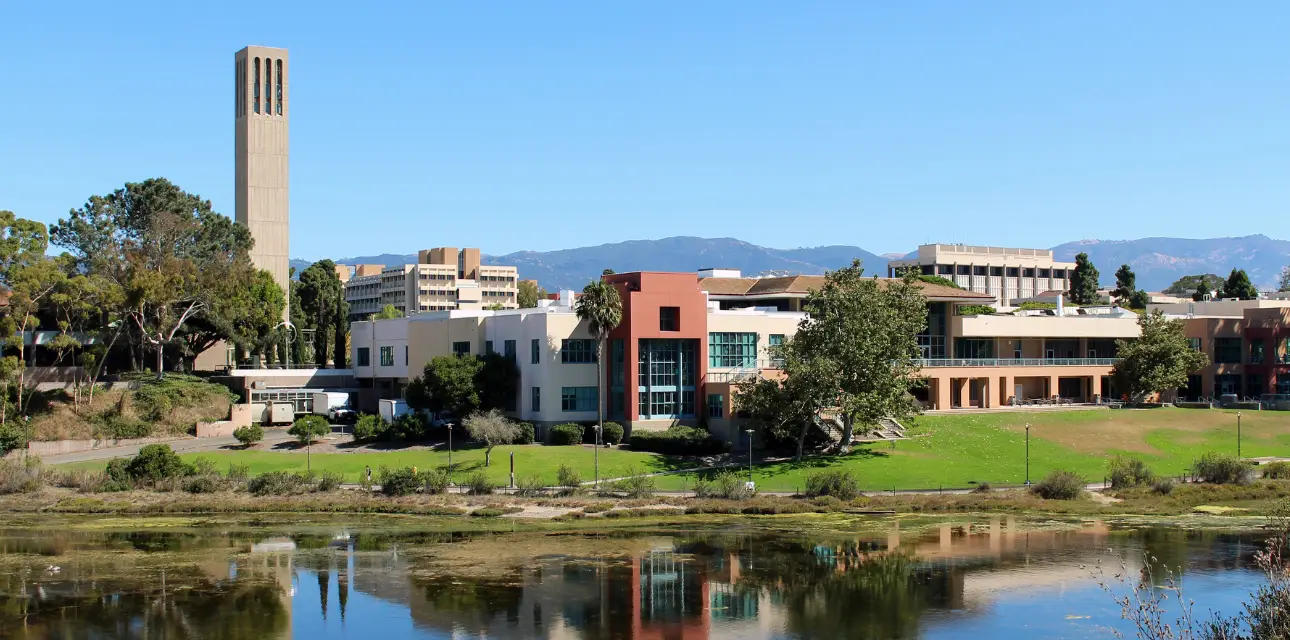
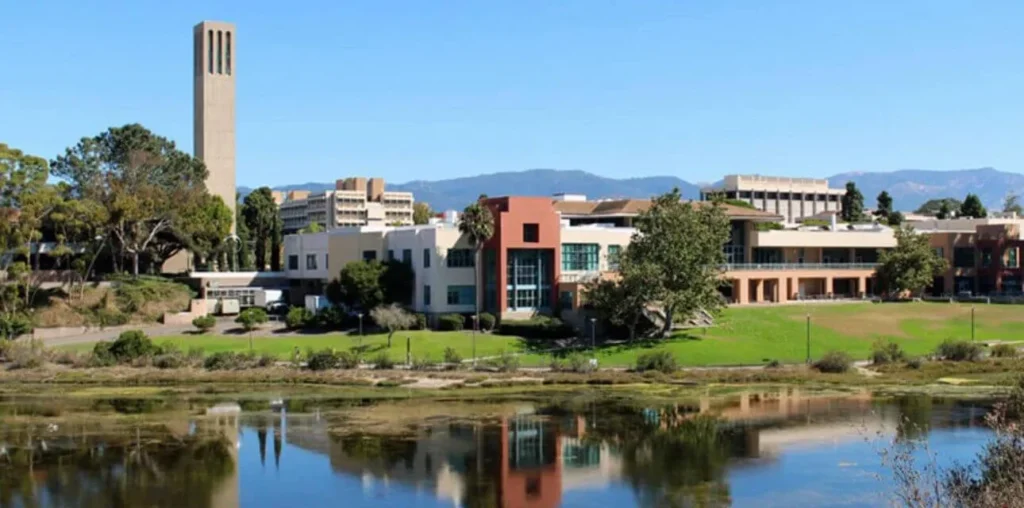
UCSB’s main campus sits on a bluff above the Pacific, next to the city of Goleta and about 10 miles west of downtown Santa Barbara. It has its own beach and lagoon, Storke Tower is its best-known landmark, and most students get around by bike.
Housing is getting better for new students. Starting in Fall 2026, UCSB guarantees two years of university-owned housing to incoming first-year and transfer students, up from one year before. In the second year, students can stay in a residence hall or move to university-owned apartments. To add space, UCSB is building the San Benito residence hall, planned to open in Fall 2027 with 2,224 beds, followed by East Campus housing with about 1,275 beds.
Our take: Most UCSB students eventually live in Isla Vista, the dense student neighborhood right next to campus. It’s walkable and social, but rents are high for what you get. The new two-year guarantee means fewer students have to enter that market as sophomores.
What Is UCSB Known For?
UC Santa Barbara is known as a serious research university that happens to sit on a beach. It began as a teachers college in 1909, joined the UC system in 1944, and today is a member of the Association of American Universities. Six UCSB faculty members have won Nobel Prizes:
- Walter Kohn, Chemistry, 1998
- Alan Heeger, Chemistry, 2000
- Herbert Kroemer, Physics, 2000
- David Gross, Physics, 2004
- Finn Kydland, Economics, 2004
- Shuji Nakamura, Physics, 2014
That research strength shows up in physics, materials science, chemical engineering, marine science, environmental studies, communication and economics, and in the Kavli Institute for Theoretical Physics, which Walter Kohn founded. In the U.S. News 2027 rankings, UCSB is No. 14 among public universities and No. 44 among national universities.
The Gauchos compete in NCAA Division I in the Big West Conference, with well-known soccer and volleyball programs.
Frequently Asked Questions
What is the UC Santa Barbara acceptance rate?
The UC Santa Barbara acceptance rate was 44.0% for first-year applicants in Fall 2026, or 47,716 of 108,512, according to the University of California. For Fall 2025 the rate was 38.2%, and 32.1% for California residents.
What is UCSB’s out-of-state acceptance rate?
UCSB admitted 54.5% of out-of-state first-year applicants for Fall 2025, or 9,302 of 17,067, according to its Common Data Set. Only about 8% of those admits enrolled.
How much is UCSB tuition for in-state students?
For 2026-27, new California residents pay $15,588 in systemwide tuition and fees plus $2,085 in campus fees. The full cost of attendance in a residence hall is $50,946.
What is UCSB’s undergraduate population?
UCSB enrolled 23,091 undergraduates in Fall 2025, out of 26,035 students in total.
What GPA do you need for UCSB?
There’s no cutoff beyond UC minimums, but the middle 50% of Fall 2026 admits had high school GPAs from 4.05 to 4.27.
Does UCSB guarantee housing?
Yes. Starting in Fall 2026, UCSB guarantees two years of university-owned housing to incoming first-year and transfer students.
The Bottom Line on UC Santa Barbara
The UC Santa Barbara acceptance rate was 44.0% for first-year applicants in Fall 2026, but California residents face tougher odds than out-of-state applicants, and admitted students typically have weighted GPAs above 4.0. Transfer applicants do much better, with a 61.6% admit rate.
For 2026-27, plan for about $51,000 a year in a residence hall if you’re a California resident, before aid, and about $90,000 if you’re not. Apply by November 30, and compare UCSB with UC Santa Cruz, UC Davis and other UC campuses on the same application.
Sources
- University of California. “Santa Barbara: First-Year Admit Data.” Fall 2026.
- University of California. “Santa Barbara: Transfer Admit Data.” Fall 2026.
- UC Santa Barbara Institutional Research, Planning and Assessment. “Common Data Set 2025-26.” ucsb.edu.
- UCSB Office of Financial Aid and Scholarships. “UCSB Undergraduate Cost of Attendance Budget.” ucsb.edu.
- Daily Nexus. “UCSB Extends Freshmen and Transfer Student Housing Guarantee to 2 Years.” July 1, 2026.
- University of California. “U.S. News 2027 Best Colleges Rankings.” universityofcalifornia.edu.
- UC Santa Barbara Magazine. “Three Decades of Dedication and Progress.” Spring-Summer 2025.
- University of California. “Blue and Gold Opportunity Plan.” universityofcalifornia.edu.

CalChannel Editorial Team California college guides
The CalChannel editorial team researches and writes guides to California colleges, admissions and financial aid. We build our college profiles and aid guides from colleges’ own published data, federal IPEDS data and the California Student Aid Commission. Read our editorial policy.