Cal State (CSU) guide · By CalChannel Editorial Team · Updated October 5, 2026
The SJSU acceptance rate was 80.4% for Fall 2025: San José State University admitted 29,845 of 37,124 first-year applicants, according to its Common Data Set. SJSU is a California State University campus in downtown San José, in the heart of Silicon Valley. For 2026-27, full-time tuition and fees are $9,553, and the cost of attendance in campus housing is $37,735.
San José State is the oldest public university in California and one of the largest in the Cal State system. It’s known for engineering, computer science and business, and for its many graduates working at Silicon Valley tech companies.
At SJSU, the campus-wide admit rate matters less than two other things: which major you choose and whether you graduate from a high school in Santa Clara County. This guide explains both, using SJSU’s 2025-26 Common Data Set, its admission rules for Fall 2027 and its 2026-27 student budget.
| Fact | San José State University |
|---|---|
| Type | Public university, California State University system |
| Location | Downtown San José, Silicon Valley |
| Founded | 1857 |
| Acceptance rate | 80.4% (Fall 2025: 29,845 admitted of 37,124 applicants) |
| Transfer acceptance rate | 82.9% (Fall 2025: 7,662 of 9,242) |
| Average high school GPA | 3.50 (Fall 2025 enrolled first-years) |
| SAT/ACT | Not used for admission (CSU policy) |
| Students | 40,037 total, 29,890 undergraduates (Fall 2025) |
| Tuition and fees, California residents (2026-27) | $9,553 (full-time) |
| Cost of attendance (2026-27) | $37,735 in campus housing; $27,483 living with parents |
| Retention / graduation rate | 89% / 68% in six years (2019 cohort) |
| Student-to-faculty ratio | 27:1 |
| Athletics | Spartans, NCAA Division I, Mountain West Conference |
Sources: San José State Common Data Set 2025-26; SJSU Financial Aid and Scholarship Office, Cost of Attendance 2026-27. Full list at the end of the article.
In This Article
- San José State: California’s Oldest Public University
- SJSU Acceptance Rate and Impacted Majors
- How SJSU Ranks Applicants by Major
- SJSU Cost: Why Housing Matters More Than Tuition
- How Many SJSU Students Graduate?
- Downtown San José and Silicon Valley Access
- Engineering, Computer Science and Tech Careers
- Frequently Asked Questions
San José State: California’s Oldest Public University
SJSU is San José State University, a public university founded in 1857 and part of the California State University system. It’s the oldest public university in California, and it began as a school for training teachers before moving to San José in 1871.
SJSU is not a UC campus. Students apply through Cal State Apply and pay CSU tuition. The university runs on semesters and offers bachelor’s, master’s and doctoral degrees through colleges including the Davidson College of Engineering, the Lucas College and Graduate School of Business, the College of Science, the College of Health and Human Sciences, and the College of Information, Data and Society.
SJSU Acceptance Rate and Impacted Majors
San José State admitted 80.4% of first-year applicants for Fall 2025: 37,124 students applied, 29,845 were admitted and 4,943 enrolled, according to its Common Data Set 2025-26. For California residents, the rate was 80.7%.
| SJSU, Fall 2025 | Applied | Admitted | Acceptance rate | Enrolled |
|---|---|---|---|---|
| First-year, California residents | 34,882 | 28,137 | 80.7% | 4,750 |
| First-year, out-of-state | 1,432 | 1,070 | 74.7% | 76 |
| First-year, international | 810 | 638 | 78.8% | 117 |
| All first-year applicants | 37,124 | 29,845 | 80.4% | 4,943 |
| Transfer applicants | 9,242 | 7,662 | 82.9% | 3,738 |
Source: San José State University Common Data Set 2025-26, items C1, C2 and D2.
The overall rate hides big differences by major. SJSU admits students to a specific major, and high-demand programs such as computer science, engineering, nursing and business are impacted, meaning they have more qualified applicants than space and use higher admission thresholds.
How SJSU Ranks Applicants by Major
SJSU follows CSU admission rules: complete the A-G course pattern with at least a 2.5 GPA as a California resident. SAT and ACT scores are not used. Enrolled first-years for Fall 2025 averaged a 3.50 high school GPA. Impacted majors such as computer science and engineering are much harder than the overall SJSU acceptance rate suggests.
- Application: Cal State Apply; for Fall 2027, the CSU priority filing period ends November 30, 2026, and decisions arrive by the end of February
- Major: you’re admitted to a major, and impacted majors are much more competitive than the campus average
- Tests: SAT and ACT scores are not considered
- Early admission: SJSU does not offer early decision or early action
- Transfers: SJSU admitted 83% of transfer applicants for Fall 2025, and students completing an Associate Degree for Transfer get priority consideration in similar majors
Local Admission at SJSU
SJSU says admission is competitive in all majors. Applicants who meet CSU minimums are ranked within their chosen major and admitted up to that major’s capacity, so the threshold differs from one major to the next. Local applicants get a boost: first-year applicants who graduate from a high school in Santa Clara County receive 200 points in SJSU’s ranking. For transfers, the local area covers Santa Clara and Santa Cruz counties. Local status is a preference, not a guarantee of admission.
SJSU Cost: Why Housing Matters More Than Tuition
For 2026-27, SJSU’s full-time undergraduate tuition and fees for California residents are $9,553, based on the Fall 2026 registration fees of $4,776.50 per semester. The full cost of attendance is $37,735 in campus housing, $38,137 off campus and $27,483 living with parents. Nonresidents pay an additional $471 per unit.
| SJSU cost of attendance, 2026-27 (California residents) | Campus housing | Off campus | With parents |
|---|---|---|---|
| Tuition and fees | $9,553 | $9,553 | $9,553 |
| Housing | $15,543 | $14,104 | $11,461 |
| Food | $7,369 | $7,245 | included |
| Transportation | $1,121 | $2,196 | $1,976 |
| Books and supplies | $1,004 | $1,004 | $1,004 |
| Miscellaneous and personal | $2,900 | $3,790 | $3,244 |
| Instructionally related activities fee | $245 | $245 | $245 |
| Total | $37,735 | $38,137 | $27,483 |
Source: SJSU Financial Aid and Scholarship Office, 2026-2027 Cost of Attendance (Student Budget), 9-month academic year.
Cal Grants, Pell Grants and the CSU State University Grant can cover tuition for eligible Californians. SJSU notes that a one-bedroom apartment near campus averages about $2,781 a month, which is why many students commute or share housing.
Our take: SJSU’s tuition is among the lowest of any university in Silicon Valley, but housing is the real cost. Living with family saves about $10,000 a year compared with campus housing, which is why so many SJSU students commute from across the South Bay.
How Many SJSU Students Graduate?
SJSU had 40,037 students in Fall 2025, including 29,890 undergraduates, according to its Common Data Set. The student-to-faculty ratio is 27:1.
About 89% of first-year students returned for their second year. Of the 2019 entering class, 37% graduated in four years and 68% within six years.
Downtown San José and Silicon Valley Access
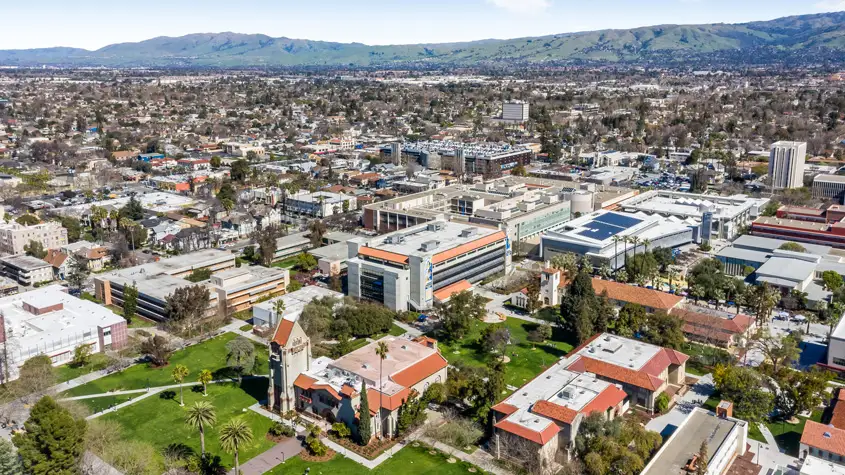
SJSU’s campus is in downtown San José, the largest city in Silicon Valley, about 50 miles south of San Francisco. The Dr. Martin Luther King Jr. Library, shared by the university and the city’s public library system, sits on campus, and the Olympic Black Power statue of alumni Tommie Smith and John Carlos stands at the center of campus.
The downtown location puts students near VTA light rail, Caltrain and major tech employers, which helps with internships and jobs.
Engineering, Computer Science and Tech Careers
SJSU is known for engineering, computer science, business, nursing, journalism and kinesiology, and for strong ties to Silicon Valley employers. Many graduates work at major technology companies in the Bay Area.
The San José State Spartans compete in NCAA Division I in the Mountain West Conference.
Frequently Asked Questions
What is the SJSU acceptance rate?
San José State admitted 80.4% of first-year applicants for Fall 2025, or 29,845 of 37,124, according to its Common Data Set.
Is SJSU hard to get into?
For most majors, no. But impacted majors such as computer science, engineering and nursing are far more competitive than the overall rate suggests.
How much does SJSU cost?
For 2026-27, full-time tuition and fees for California residents are $9,553. The cost of attendance is $37,735 in campus housing and $27,483 living with parents.
Do local students get priority at SJSU?
Yes. First-year applicants from Santa Clara County high schools receive 200 points in SJSU’s major-by-major ranking, though local status doesn’t guarantee admission.
Is SJSU a UC?
No. San José State is part of the California State University system, not the University of California.
How many students attend SJSU?
SJSU enrolled 40,037 students in Fall 2025, including 29,890 undergraduates.
Is SJSU a Good Choice for Your Major?
San José State is the oldest public university in California and a major source of talent for Silicon Valley. Most applicants are admitted, but admission to impacted majors is much more competitive.
For California residents, plan for $9,553 in tuition and fees and about $37,700 a year in campus housing before aid. Compare SJSU with Cal Poly SLO, San Diego State, CSU Monterey Bay and other Cal State campuses.
Sources
- San José State University Institutional Research. “Common Data Set 2025-26.” sjsu.edu.
- SJSU Financial Aid and Scholarship Office. “Cost of Attendance.” sjsu.edu.
- SJSU Bursar’s Office. “Fall Registration Fees.” sjsu.edu.
- SJSU Admissions. “Impaction.” sjsu.edu.
- California State University. “Apply: Priority Dates and Deadlines.” calstate.edu.
- Wikipedia. “San Jose State University.” Wikipedia.org.

CalChannel Editorial Team California college guides
The CalChannel editorial team researches and writes guides to California colleges, admissions and financial aid. We build our college profiles and aid guides from colleges’ own published data, federal IPEDS data and the California Student Aid Commission. Read our editorial policy.