
University of California guide · By CalChannel Editorial Team · Updated October 1, 2026
UC Merced is the newest University of California campus, opened in 2005 next to Lake Yosemite on the northeast edge of Merced, in California’s San Joaquin Valley. It admitted 94.7% of first-year applicants for Fall 2026, became an R1 research university in 2025 and ranks No. 4 in the nation for social mobility in U.S. News 2027.
Most people searching for this campus want to know what kind of place it is: a real UC campus or a smaller satellite, a big school or a small one, a city campus or a rural one. The short answers are full UC campus, small, and Central Valley. Here’s the longer version, followed by admission odds and what it costs.
| Fact | UC Merced |
|---|---|
| Opened | 2005, the tenth UC campus |
| Location | Merced, San Joaquin Valley, next to Lake Yosemite |
| Campus | About 1,026 acres |
| Students (Fall 2025) | 8,934 total; 8,234 undergraduates |
| First-year admit rate | 94.7% (Fall 2026); 97.0% (Fall 2025) |
| Transfer admit rate | 67.5% (Fall 2026) |
| Research status | R1, very high research activity (2025) |
| U.S. News 2027 | No. 4 social mobility; No. 30 public; No. 69 National Universities |
| Cost of attendance, on campus (2026-27) | $48,654 for new California residents |
| Calendar and mascot | Semester system; Bobcats |
Sources: UC Merced Common Data Set 2025-26; University of California admit data for Fall 2026; UC Merced Office of Financial Aid and Scholarships; University of California summary of U.S. News 2027 rankings.
In This Article
Is UC Merced a Real UC Campus?
Yes. It is one of the ten campuses of the University of California, with the same degrees, systemwide tuition and admission requirements as UCLA or UC Berkeley. It opened in 2005 as the first new UC campus in decades and the first American research university built in the 21st century.
It has grown up quickly. In 2025, just 20 years after opening, the campus was classified as an R1 university, the highest research-activity category in the Carnegie Classification. In the U.S. News 2027 rankings it ranks No. 30 among public universities, No. 69 among national universities and No. 4 in the nation for social mobility.
What makes it feel different from older UC campuses is its size. With 8,934 students in Fall 2025, including 8,234 undergraduates, it’s by far the smallest UC campus. It also runs on semesters rather than quarters, and undergraduates study in three schools: Engineering; Natural Sciences; and Social Sciences, Humanities and Arts.
The UC Merced Campus
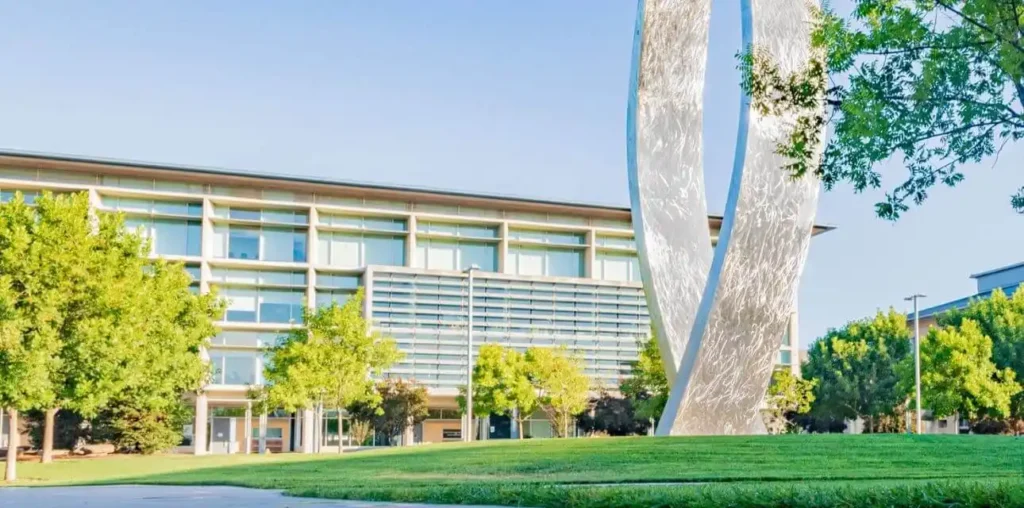
The campus covers about 1,026 acres next to Lake Yosemite, a reservoir on the northeast edge of Merced. The university also manages thousands of acres of protected grassland and vernal pool habitat nearby, which students and faculty use for environmental research.
Because it’s so new, the whole campus was designed with sustainability in mind. The university says every building on campus is LEED certified, a distinction few universities can claim. Its biggest expansion, the 2020 Project, was a $1.2 billion development that added 11 buildings, including labs, student housing, a conference center and recreation fields, and roughly doubled the campus’s physical capacity. Those buildings were designed around “triple net zero” goals: zero net energy, zero landfill waste and zero net greenhouse gas emissions.
Day to day, the campus is compact and walkable, with shaded paths and quads rather than long distances between buildings. It is also one of the UC campuses that offers new students a two-year housing guarantee.
Our take: This campus suits students who want a UC degree without the crowds. Classes and labs are smaller than at the large UC campuses, but the trade-off is a quieter Central Valley location, where a car or the local bus makes a big difference.
Where Is UC Merced?
The campus is in the city of Merced, in California’s San Joaquin Valley, about five miles from downtown. It’s roughly two hours by car from both Yosemite National Park and the San Francisco Bay Area, and Amtrak’s San Joaquins trains stop in Merced.
Why build a UC campus here rather than near a big city? The University of California chose the San Joaquin Valley to expand access to higher education in a fast-growing region that had no UC campus and low college-going rates. That mission still shapes the campus, which enrolls many first-generation college students from the Central Valley.
UC Merced Acceptance Rate
UC Merced admitted 94.7% of first-year applicants for Fall 2026: 49,426 applied and 46,812 were admitted, according to admit data published by the University of California. The middle 50% of admits had high school GPAs between 3.57 and 4.16. For Fall 2025, the rate was 97.0%, and 96.5% for California residents, according to UC Merced’s Common Data Set.
| UC Merced admission | Applicants | Admits | Admit rate |
|---|---|---|---|
| First-year, Fall 2026 | 49,426 | 46,812 | 94.7% |
| First-year, Fall 2025 | 47,985 | 46,564 | 97.0% |
| Transfer, Fall 2026 | 6,635 | 5,089 | 67.5% |
| Transfer, Fall 2025 | 5,148 | 3,712 | 72.1% |
Sources: University of California, UC Merced first-year and transfer admit data (Fall 2026); UC Merced Common Data Set 2025-26 (Fall 2025).
Why is the rate so high? Many students apply here alongside other UC campuses, and the campus also receives students through the UC referral pool, which offers a place to eligible California applicants who weren’t admitted to the campuses they chose. Only about 4% of Fall 2025 admits enrolled, so the campus admits broadly to fill its class. For a California student who completes the A-G courses with at least a 3.0 GPA, it’s close to a sure admit.
The usual UC rules apply: the UC application is due November 30, the fee is $80 per campus for domestic applicants with fee waivers for students with financial need, and SAT and ACT scores aren’t considered. It also takes part in the UC Transfer Admission Guarantee for eligible California community college students.
How Much Does UC Merced Cost?
For undergraduates who first enroll in Fall 2026, the university estimates a cost of attendance for California residents of $48,654 on campus, $41,834 off campus and $36,052 living at home. Fees are $17,024, and nonresidents add $39,270 in Nonresident Supplemental Tuition.
| UC Merced, new students 2026-27 (California residents) | On campus | Off campus | At home |
|---|---|---|---|
| Fees | $17,024 | $17,024 | $17,024 |
| Housing and food | $23,180 | $14,814 | $8,790 |
| Books and supplies | $1,148 | $1,148 | $1,148 |
| Transportation and personal | $4,226 | $5,772 | $6,014 |
| Health insurance and loan fee | $3,076 | $3,076 | $3,076 |
| Total, California residents | $48,654 | $41,834 | $36,052 |
| Total, nonresidents | $87,924 | $81,104 | $75,322 |
Source: UC Merced Office of Financial Aid and Scholarships, Cost of Attendance 2026-27, undergraduates who first enroll in Fall 2026.
Off-campus living in Merced is cheaper than in most UC towns: the off-campus budget is about $6,800 below living on campus. For California families, grants lower the cost further. UC’s Blue and Gold Opportunity Plan covers UC tuition for most families earning up to $100,000, and Cal Grants, Pell Grants and the Middle Class Scholarship can help with living costs.
What Is UC Merced Known For?
The campus is known for sustainability, for research tied to the San Joaquin Valley, such as water resources, climate and agriculture, and for strengths in cognitive science and engineering. Business and management programs are offered through the Ernest and Julio Gallo Management Program.
It’s also known for who it serves. Its No. 4 national ranking for social mobility reflects how many lower-income and first-generation students it enrolls and graduates. About 85% of first-year students return for a second year, and 68% of the 2019 entering class graduated within six years, including 51% in four.
Frequently Asked Questions
Is UC Merced a real UC?
Yes. It is one of the ten University of California campuses and awards the same UC degrees and follows the same systemwide tuition and admission rules as the other campuses.
How big is the UC Merced campus?
The UC Merced campus covers about 1,026 acres next to Lake Yosemite. It enrolled 8,934 students in Fall 2025, which makes it the smallest UC campus by enrollment.
Where is UC Merced?
UC Merced is in Merced, California, in the San Joaquin Valley, about two hours by car from Yosemite National Park and the San Francisco Bay Area.
What is the UC Merced acceptance rate?
UC Merced admitted 94.7% of first-year applicants for Fall 2026, or 46,812 of 49,426, according to the University of California. The Fall 2025 rate was 97.0%.
How much does UC Merced cost?
For new California students in 2026-27, UC Merced estimates $48,654 on campus, $41,834 off campus and $36,052 living at home. Nonresidents add $39,270.
When did UC Merced open?
UC Merced opened in 2005 as the tenth University of California campus. It reached R1 research status in 2025.
The Bottom Line on UC Merced
This is the newest and smallest UC campus: about 1,026 acres beside Lake Yosemite, fewer than 9,000 students and an R1 research classification earned in just 20 years. It admitted 94.7% of first-year applicants for Fall 2026, making it the most reliable path to a UC degree for qualified California students.
Plan for about $48,700 a year on campus or $36,000 living at home before aid. Apply by November 30, and compare UC Merced with UC Riverside, UC Santa Cruz and other UC campuses on the same application.
Sources
- University of California. “Merced: First-Year Admit Data” and “Transfer Admit Data.” Fall 2026.
- UC Merced Center of Institutional Effectiveness. “Common Data Set 2025-26.” ucmerced.edu.
- UC Merced Office of Financial Aid and Scholarships. “Cost of Attendance.” ucmerced.edu.
- University of California. “U.S. News 2027 Best Colleges Rankings.” universityofcalifornia.edu.
- Building Design + Construction. “UC Merced’s Completed 2020 Project Roughly Doubles the Campus’ Physical Capacity.”
- Wikipedia. “University of California, Merced.” Wikipedia.org.

CalChannel Editorial Team California college guides
The CalChannel editorial team researches and writes guides to California colleges, admissions and financial aid. We build our college profiles and aid guides from colleges’ own published data, federal IPEDS data and the California Student Aid Commission. Read our editorial policy.