
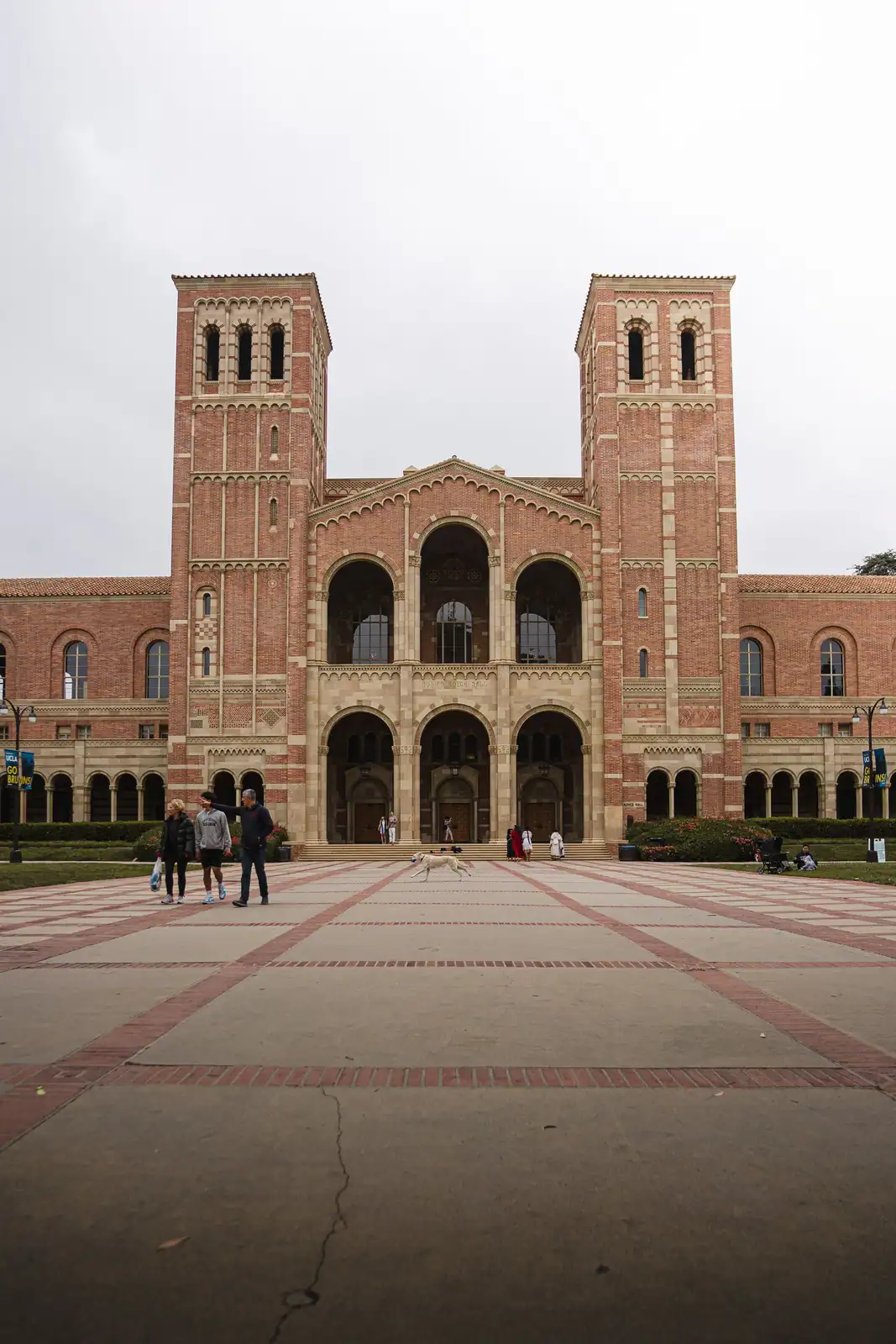
The UCLA transfer acceptance rate came to 22.2% for Fall 2026 in the June 17, 2026 snapshot (6,796 admits from 30,668 applicants), and to 25.4% for California community college applicants (6,282 of 24,751). Residency changes the odds about threefold. In Fall 2025, UCLA admitted 22.9% of California residents (5,525 of 24,174), 7.3% of out-of-state US applicants (57 of 776) and 2.0% of applicants coming straight from a foreign university (5 of 250); the June 2026 snapshot puts out-of-state at 5.2% (44 of 846).
Your intended major moves the odds more than any single headline number, so check the major tables before you read too much into 22.2%.
| Fact | Value | Year and source |
|---|---|---|
| Transfer admit rate, all applicants | 22.2% (6,796 / 30,668) | Fall 2026, June 17, 2026 snapshot; UC Admissions |
| California community college applicants | 25.4% (6,282 / 24,751) | Fall 2026, offers as of June 17, 2026; UCOP preliminary tables (CCC only) |
| California residents | 22.9% (5,525 / 24,174) | Fall 2025 final; UC Information Center |
| Out-of-state US applicants | 7.3% (57 / 776) | Fall 2025 final; UC Information Center |
| Out-of-state US applicants | 5.2% (44 / 846) | Fall 2026, June 2026 snapshot; UCOP |
| Applying directly from a foreign university | 2.0% (5 / 250) | Fall 2025 final; UC Information Center |
| Median GPA of admitted transfers | 3.91 | Fall 2025; UCLA Transfer Profile |
| Fall 2027 filing period | October 1 to November 30, 2026 | UC Admissions; UCLA |
| Admission decisions | Late April | UCLA Undergraduate Admission |
Source: UC Admissions; UC Information Center; UCOP preliminary tables; UCLA Undergraduate Admission (all read October 22, 2026).
UCLA Transfer Acceptance Rate: Which Number Applies to You?
It depends on your residency and on where you apply from. California residents and community college applicants sit in the low to mid 20s, while out-of-state US applicants sit in single digits.
| Applicant group | Fall 2024 final | Fall 2025 final | June 2026 snapshot (preliminary) |
|---|---|---|---|
| California resident | 24.0% (5,606 / 23,338) | 22.9% (5,525 / 24,174) | 21.9% (5,778 / 26,349) |
| Out-of-state US | 6.5% (51 / 782) | 7.3% (57 / 776) | 5.2% (44 / 846) |
| International | 17.0% (520 / 3,058) | 26.4% (884 / 3,351) | 28.2% (974 / 3,450) |
| California community college applicants (any residency) | 26.5% (5,719 / 21,551) | 26.4% (5,964 / 22,606) | 25.4% (6,282 / 24,751) |
Source: UC Information Center (Fall 2024 and Fall 2025 final); UC counselor CCC transfer data (Fall 2024 and 2025); UCOP preliminary tables (CA, out-of-state, international and CCC rows), offers as of June 17, 2026.
Here’s what the data actually shows. In Fall 2025, the California resident rate was 3.1 times the out-of-state US rate, and that gap is not a one-year blip: from Fall 2017 to Fall 2025, the out-of-state US rate ran from 4.2% to 8.2% a year (median 6.6%), with 39 to 58 admits a year. Pooled over those nine years, the UCLA transfer acceptance rate out of state works out to 6.6% (442 of 6,723 applicants), against 24.1% for California residents.
Out-of-state students are a tiny share of the entering class. Only 35 of the 3,933 transfers who enrolled in Fall 2025 came from other states, or 0.9%.
International applicants look better off at first glance, at 26.4% in Fall 2025. But only 5 of those admits came straight from foreign universities (5 of 250 applicants, 2.0%), so nearly all international admits were already enrolled at US institutions. The foreign-institution rate was 2.4% (6 of 252) in Fall 2022 and 2.3% (5 of 219) in Fall 2023; other years are redacted.
The community college row runs higher than the California resident row in the same June 2026 snapshot, 25.4% against 21.9%. Community college admits outnumber California-resident admits by 504 (6,282 minus 5,778), because the community college count includes nonresidents attending California community colleges.
Some college-advice sites quote 21.9% as the 2026 rate for all transfers. That number is the California-resident row only (5,778 of 26,349).
How this was calculated: the admit rate equals admits divided by applicants for each residency group and year, and the California, out-of-state and international rows add up to the total in all 9 final years and all 3 June snapshots. Final data through Fall 2025 comes from the UC Information Center admissions summary (page updated January 23, 2026), and Fall 2026 comes from UCOP preliminary tables with offers as of June 17, 2026. The CalChannel Editorial Team read all of it on October 22, 2026.
UCLA Transfer Statistics by Year, 2017 to 2026
On UCLA’s own profiles, the UCLA transfer rate ranged from 19.1% in Fall 2021 to 25.8% in Fall 2023 over 2020 to 2025. No official source explains the 2021 low.
| Fall | Applicants | Admits | Enrolled | Admit rate | Source |
|---|---|---|---|---|---|
| 2017 | 21,871 | 5,531 | 3,166 | 25.3% | UC Information Center |
| 2018 | 23,758 | 5,574 | 3,427 | 23.5% | UC Information Center |
| 2019 | 24,114 | 5,334 | 3,282 | 22.1% | UC Information Center |
| 2020 | 25,957 | 6,271 | 3,791 | 24.2% | UCLA Transfer Profile |
| 2021 | 28,457 | 5,435 | 3,436 | 19.1% | UCLA Transfer Profile |
| 2022 | 24,930 | 5,961 | 3,645 | 23.9% | UCLA Transfer Profile |
| 2023 | 23,974 | 6,189 | 3,696 | 25.8% | UCLA Transfer Profile |
| 2024 | 27,177 | 6,177 | 3,832 | 22.7% | UCLA Transfer Profile |
| 2025 | 28,288 | 6,466 | 3,935 | 22.9% | UCLA Transfer Profile (published as 23%) |
| 2026 | 30,645 | 6,796 | n.a. | 22.2% (preliminary) | UCOP table 1a, offers as of June 17, 2026 |
Source: UC Information Center (2017 to 2019); UCLA Transfer Profiles (2020 to 2025); UCOP preliminary tables (2026). Rates are admits divided by applicants, rounded to one decimal.
Rows for 2020 to 2025 come from the UCLA Transfer Profile pages, which round each rate to a whole percent. That is why the Fall 2025 row reads 22.9% here and 23% on UCLA’s site.
Applications grew faster than admits. From Fall 2017 to Fall 2025, applicants rose 29.4% and admits rose 16.9% on InfoCenter counts. From Fall 2020 to the Fall 2026 preliminary count, applicants rose 18.1% (25,957 to 30,645) while admits rose 8.4% (6,271 to 6,796).
Why the Same Year Has Different Counts
| Counter | Applicants | Admits | Enrolled | Rate | What it is |
|---|---|---|---|---|---|
| UCLA Transfer Profile | 28,288 | 6,466 | 3,935 | 22.9% | UCLA’s own report, Fall 2025 |
| UC Information Center | 28,301 | 6,466 | 3,933 | 22.8% | UC final data, Fall 2025 |
| UCLA Common Data Set 2025-26 (D2) | 28,487 | 6,665 | 3,933 | 23.4% | Common Data Set, Fall 2025 |
| UCOP preliminary | 28,239 | 6,403 | n.a. | 22.7% | Fall 2025, as of June 23, 2025 |
| UC Admissions | 30,668 | 6,796 | n.a. | 22.2% | Fall 2026, snapshot June 17, 2026 |
| UCOP table 1a | 30,645 | 6,796 | n.a. | 22.2% | Fall 2026, applications PDF created February 23, 2026 |
Source: UCLA Undergraduate Admission; UC Information Center; UCLA Common Data Set 2025-26; UCOP; UC Admissions (read October 22, 2026).
The two Fall 2026 counts differ by 23 applicants, with the same admit count. This guide uses the UC Admissions count of 30,668 in the summary and the UCOP count of 30,645 in the trend table.
Our UCLA college profile shows 28,487 applicants, 6,665 admits and 3,933 enrolled for Fall 2025, which is the Common Data Set count. The CDS carries 199 more applicants and 199 more admits than UCLA’s profile, with enrolled nearly identical (3,933 against 3,935), and it gives no reason for the difference. Similar CDS excesses appeared in 2020 to 2023 (125 to 187 extra admits), with none in 2024.
June numbers are not final. In 2024, the June 26 snapshot showed 6,070 admits against 6,177 final, 107 more (1.8%), and the rate moved from 22.4% to 22.7%; in 2025, 6,403 admits on June 23 became 6,466 final, 63 more (1.0%), and the rate moved from 22.7% to 22.8%. The UCOP fact sheet tables explain it this way: “The data presented are subject to change as campuses continue to admit students from their waitlists and verify that conditions of admission are met.”
UCOP does not break that increase down by reason, so it is not a count of waitlist admits. What it does show is that the Fall 2026 figure of 22.2% is preliminary, and in both years on record the rate rose slightly between June and final. The same tables add: “Transfer data does not include limited status or 2nd baccalaureate students.”
Some college-advice sites list 22.3% for Fall 2024. That figure divides 6,070 admits, the June 2024 snapshot, by 27,167 applicants, a count that matches no official source (27,150 preliminary, 27,177 on the profile and CDS, 27,178 at the InfoCenter).
UCLA Transfer Acceptance Rate by Major and School
UCLA reviews transfer applicants by the major they choose. In UCLA’s words: “Our evaluation of transfer applications is based largely on students’ preparation for the major they select and their GPAs in completed preparatory courses.”
| School | Applicants | Admits | Admit rate | Range, 2020 to 2025 |
|---|---|---|---|---|
| The College | 21,089 | 5,790 | 27% | 22.6% to 31.6% |
| Samueli School of Engineering | 4,600 | 504 | 11% | 10.1% to 11.3% |
| Herb Alpert School of Music | 257 | 45 | 18% | n.a. |
| School of the Arts and Architecture | 1,143 | 78 | 6.8% | 6.8% to 9.4% |
| School of Nursing | 304 | 20 | 6.6% | 2.5% to 7.9% |
| School of Theater, Film and Television | 895 | 29 | 3.2% | 1.8% to 3.2% |
Source: UCLA Transfer Profiles, Fall 2025 (applicants, admits, rates as published) and Fall 2020 to Fall 2024 archive (range).
The UCLA nursing transfer acceptance rate was 6.6% in Fall 2025 (20 of 304 applicants), near the top of its 2020 to 2025 band. At 11.0% (504 of 4,600), the UCLA engineering transfer acceptance rate was also near its high, in a band that has barely moved since 2020. Theater, Film and Television was the hardest school at 3.2%.
| Major | Fall 2025 applicants | Fall 2025 admit rate | Range, 2020 to 2025 |
|---|---|---|---|
| Business Economics | 3,379 | 10% | 9% to 13% |
| Psychology | 2,390 | 21% | 17% to 24% |
| Computer Science | 1,652 | 5% | 2% to 5% |
| Economics | 1,517 | 16% | 13% to 19% |
| Political Science | 1,517 | 34% | 30% to 47% |
| Sociology | 1,199 | 41% | 28% to 46% |
| Biology | 1,162 | 17% | 13% to 22% |
| Communication | 964 | 13% | 9% to 13% |
| Mechanical Engineering | 794 | 12% | 12% to 19% |
| Statistics and Data Science | 780 | 23% | 23% to 35% (2023 to 2025 only) |
| Film and Television | 632 | 3% | 1% to 3% |
| Electrical Engineering | 629 | 18% | 18% to 34% |
| English | 561 | 56% | 32% to 59% |
| History | 453 | 58% | 38% to 62% |
| Applied Mathematics | 379 | 36% | 36% to 43% |
| Computer Science and Engineering | 369 | 9% | 7% to 12% |
| Philosophy | 335 | 59% | 41% to 59% |
| Anthropology B.A. | 318 | 66% | 2025 only |
| Aerospace Engineering | 265 | 13% | 2025 only |
Source: UCLA Transfer Profile by major, Fall 2025 and Fall 2020 to Fall 2024 archive. Nursing appears in the school table.
The table shows 19 of the 50 majors with at least 100 applicants in Fall 2025; the full list is on UCLA’s by-major page. Averages for 2022 to 2024 built from these pages match UCLA’s own “Most Applied to Majors” table, for example Computer Science at 1,865 applicants a year and 4%.
Pooled over 2020 to 2025, Computer Science admitted 3.8% of 10,943 applications, Business Economics 10.6% of 16,849 and Psychology 20.8% of 13,993. Those pooled rates multiply each year’s applicants by UCLA’s published rate and add the results.
From 2024 to 2025, among 48 majors with at least 100 applicants in both years, 21 got harder, 6 stayed the same and 21 got easier. Electrical Engineering fell from 23% to 18% as applications rose from 450 to 629, after sitting at 30% to 34% in 2020 to 2023; Applied Mathematics went from 41% to 36% and Molecular, Cell and Developmental Biology from 35% to 30%. Public Affairs jumped from 24% to 46%, but on a small base of 105 and 120 applicants.
The 2020 to 2024 profiles flagged 21 to 22 College majors as “highly selective” with an asterisk, and the 2025 profile has no such flags. Fall 2026 profiles by major and by college were not published as of October 22, 2026.
What GPA Do You Need to Transfer to UCLA?
The minimum UCLA transfer GPA is a 3.2 in transferable courses under the general criterion, but several schools state their own floor. Admitted students sit well above all of them.
| School or criterion | Minimum GPA as stated by UCLA |
|---|---|
| General transfer criterion | 3.2 in transferable courses |
| Samueli School of Engineering | 3.4 at the time of application |
| Joe C. Wen School of Nursing | 3.5 cumulative in all transferable courses |
| School of the Arts and Architecture | 3.0 at the time of application |
| Herb Alpert School of Music | 3.2 at the time of application |
| School of Theater, Film and Television | 3.2 at the time of application |
| Luskin School of Public Affairs | 3.2 cumulative, end of fall term before transfer |
| School of Education and Information Studies | 3.2 cumulative, end of fall term before transfer |
| Fielding School of Public Health | 3.2 at the time of application |
| The College | None stated; “Some majors are highly selective; for these we look for stronger preparation” |
Source: UCLA Undergraduate Admission, transfer requirements and major preparation pages (read October 22, 2026).
Each figure appears as stated on its own UCLA page, so the 3.0 for Arts and Architecture and the general 3.2 both stand as written. The Engineering page adds: “Please note that admission to the Samueli School of Engineering is highly selective.”
The competitive level is much higher. UCLA says: “The average GPA of admitted transfer students is above 3.5 and admitted students have completed most or all major preparatory courses.” In Fall 2025, admitted transfers had a median GPA of 3.91, with a middle 50% of 3.77 to 4.00.
Fall 2026 community college admits had a middle 50% of 3.79 to 4.00. That 3.79 is the highest 25th percentile among the nine UC campuses (Berkeley: 3.68).
| 25th-percentile admit GPA | Majors | Applications | Share of applications | Pooled admit rate |
|---|---|---|---|---|
| 3.90 or higher | 12 | 7,718 | 29.7% | 12.9% |
| 3.70 to 3.89 | 25 | 14,894 | 57.3% | 21.7% |
| Below 3.70 | 13 | 3,380 | 13.0% | 44.9% |
Source: UCLA Transfer Profile by major, Fall 2025; 50 of 132 majors, those with at least 100 applicants.
The top band includes Computer Science (25th to 75th percentile admit GPA 4.00 to 4.00), Statistics and Data Science (3.94 to 4.00), Bioengineering (3.96 to 4.00) and Mechanical Engineering (3.92 to 4.00). The bottom band includes English (3.63 to 3.95), History (3.68 to 4.00), Philosophy (3.60 to 3.92), Anthropology (3.55 to 3.92), Public Affairs (3.55 to 3.86), Education and Social Transformation (3.58 to 3.92) and Art History (3.57 to 3.94). Art (3.44) and Nursing Prelicensure (3.68) also sit in the low band, but both select on portfolio or supplemental material.
With a GPA below 3.90 and a top-band major in mind, build a plan B: an adjacent major or another campus. With a 3.6 to 3.8, majors in the bottom band are a realistic target. The lowest 25th-percentile admit GPA among majors with at least 100 applicants in Fall 2025 was Art’s 3.44, which marks the floor of observed admits, not a rule.
Some sites claim the average GPA of admitted transfers is 2.4. That number is the Common Data Set “minimum college GPA” field (2.4 for California residents, 2.8 for nonresidents), not an average.
UCLA Transfer Requirements: Units, Courses and Major Prep
UCLA’s base rule is “Junior-level standing (60 semester or 90 quarter transferable units completed) by the end of the spring term before you transfer.” On top of that come a seven-course pattern and preparation for the major you choose.
The seven courses must be done by the spring before transfer:
- Two transferable courses in English composition or critical thinking and writing.
- One transferable math course with an intermediate algebra prerequisite or higher.
- Four transferable courses in at least two of these areas: arts and humanities, social and behavioral sciences, physical and biological sciences.
UC-to-UC applicants who were admitted to their UC campus as first-years do not need the pattern.
The workable range is 60 to 86 semester or 90 to 129 quarter units by the end of spring before the fall you apply for. Lower-division transferable credit is capped at 70 semester or 105 quarter units, while UC and upper-division units are not capped and “can put you at risk of exceeding the maximum for transfer eligibility and becoming senior-level.” Nursing asks for “90 to 105 quarter units (60 to 70 semester units) of transferable coursework”.
Completing IGETC or Cal-GETC is “only required for admission to majors in the Joe C. Wen School of Nursing and School of Theater, Film and Television,” and “For the School of Engineering, IGETC/Cal-GETC is not recommended.” Partial IGETC is accepted if it is not missing Areas 1 and 2; the Engineering page says partial IGETC will not be accepted for its majors. Partial Cal-GETC is not accepted, and Nursing requires full certification upon entrance.
There is no undeclared route: “No. Transfer students must apply to a specific major.” UCLA also notes: “The most competitive applicants for business economics, economics and psychology will have completed all major prep by the end of fall prior to transfer.”
Two more rules: “UCLA doesn’t require or accept letters of recommendation or official transcripts during the admission selection process.” And “UCLA admits students for fall quarter only.”
Community College vs UC vs CSU: Where You Transfer From Matters
Community college applicants get the first look. UCLA states: “We give highest priority to applicants from California community colleges and other UC campuses.” Its FAQ adds that community college applicants are considered first, then UC-to-UC applicants.

| Transferring from | Fall 2025 applicants | Fall 2025 admits | Fall 2025 rate | Pooled rate, 2020 to 2025 |
|---|---|---|---|---|
| California community college | 22,583 | 5,940 | 26% (26.3%) | 26.1% (33,755 / 129,101) |
| Another UC campus | 2,234 | 330 | 15% (14.8%) | 15.8% (1,581 / 10,006) |
| CSU campus | 687 | 28 | 4.1% | 5.5% (198 / 3,590) |
| Other schools | 2,784 | 168 | 6.0% | 6.0% (965 / 16,086) |
Source: UCLA Transfer Profiles, Fall 2020 to Fall 2025.
All non-community-college applicants combined were admitted at 8.0% to 11.1% each year from 2020 to 2025. Community college applicants made up 79% to 85% of applications and 92% to 93% of admits in those years; UCLA’s 2025 page shows both 92% and 93% because of rounding.
UC-to-UC applications grew from 1,016 in 2020 to 2,234 in 2025 (up 120%), while their rate fell from 20.4% to 14.8%. You “must leave or have left your previous UC campus in good academic standing,” and finishing your current UC campus’s general education exempts you from UCLA’s.
| College | 2025 applications | 2025 rate | Range, 2020 to 2025 | TAP member |
|---|---|---|---|---|
| Santa Monica College | 1,859 | 34% | 26% to 36% | Yes |
| Pasadena City College | 1,366 | 30% | 27% to 36% | Yes |
| De Anza College | 1,126 | 22% | 17% to 23% | Yes |
| Irvine Valley College | 1,026 | 31% | 23% to 34% | Yes |
| Mt. San Antonio College | 787 | 34% | 22% to 36% | Yes |
| Diablo Valley College | 743 | 28% | 23% to 28% | No |
| Los Angeles Pierce College | 653 | 36% | 31% to 44% | Yes |
| El Camino College | 619 | 31% | 27% to 35% | Yes |
| Santa Barbara City College | 611 | 20% | 14% to 25% | Yes |
| Orange Coast College | 592 | 22% | 22% to 31% | Yes |
Source: UCLA Transfer Profile by community college, Fall 2025 and Fall 2020 to Fall 2024 archive; TAP membership from UCLA’s Transfer Alliance Program page.
These ten colleges sent 41.5% of all community college applications in 2025 (9,382 of 22,583). College rates are fairly stable: across 57 colleges with at least 100 applicants in both 2024 and 2025, the correlation was r = 0.72 and the average change was 2.9 points.
But there’s a catch. College-level rates do not adjust for each college’s major mix, and UCLA counts only the last institution you attended. So “transfer to college X because its rate is higher” is not a valid conclusion from this table.
TAP, ADT and TAG: What Actually Helps a UCLA Transfer Application
TAP helps in some majors, ADT is a pilot at 10 community colleges, and TAG does not exist at UCLA.
| Program | Who can use it | What it gives | Guarantee? |
|---|---|---|---|
| TAP (Transfer Alliance Program) | Students who complete the honors or scholars program at one of 56 member community colleges | Priority consideration for College majors, public health, public affairs, and education and social transformation; alternate-major review | No |
| ADT Pilot | Students at 10 named community colleges; California residents or AB 540 eligible | Admission route for ADT majors with a 3.5 minimum GPA | Not described as one; admission can be rescinded if terms are not met |
| TAG | Not offered at UCLA | Offered at six other UC campuses | Not available for UCLA |
Source: UCLA Transfer Alliance Program and ADT pages; UC Admissions TAG page (read October 22, 2026).
The UCLA Transfer Alliance Program links UCLA with 56 community colleges, including Santa Monica, Pasadena City, De Anza, Irvine Valley, Mount San Antonio and Los Angeles Pierce. In UCLA’s words: “Applicants are given priority consideration for admission to majors in the College, as well as the following majors: public health, public affairs and education and social transformation.” Certification takes the UC application, the TAP Applicant Agreement Form and completion of your college’s honors or scholars program.
TAP also opens alternate-major review: “We do not review non-Transfer Alliance Program applicants for admission to alternate majors.” The alternate must be listed on the UC application, changes are due by January 31, and the Samueli School of Engineering, the School of the Arts and Architecture, the Herb Alpert School of Music, the School of Nursing and the School of Theater, Film and Television do not participate.
Two limits apply: “Effective May 2026, one-year transfer students will not be eligible for TAP certification,” and Fall 2027 entrants must have been college students for at least two years after high school by the end of Spring 2027.
UCLA’s FAQ is blunt: “Is there a minimum GPA that guarantees admission? No. The Transfer Alliance Program is not an admission guarantee program.”
Fourteen majors are restricted as alternates:
- Biology
- Pre-business economics
- Communication
- Pre-economics
- Education and social transformation
- Global studies
- Human biology and society (B.A. and B.S.)
- Mathematics/economics
- Financial actuarial mathematics
- Political science
- Psychology
- Public Health B.A. and B.S.
- Sociology
- Statistics and data science
Applicants from the 56 member colleges had a pooled admit rate 2.9 to 5.2 points higher than applicants from non-member colleges every year from 2020 to 2025; in 2025 it was 27.5% (17,833 applications) against 22.3% (4,750).
The method multiplies applicants by UCLA’s published, rounded college rate and adds the results, using the current 2026 member list. UCLA does not publish individual TAP status, so this is a college-level correlation, not a program effect or a guarantee.
The ADT Pilot runs at 10 community colleges: Antelope Valley, Bakersfield, Compton, Crafton Hills, Cypress, East Los Angeles, Oxnard, Rio Hondo, San Bernardino Valley and West Los Angeles. You need a minimum cumulative GPA of 3.5 for all ADT majors, at least 30 UC-transferable semester units at the certifying college (which must be your last institution), and California residency or AB 540 eligibility. Two English composition courses and one math course must be done by the end of fall with a B or better, and no more than 19 UC-transferable semester units can be in progress in spring.
Majors include Anthropology, Atmospheric and Oceanic Sciences, Earth and Environmental Science, Geology, History, Mathematics, Philosophy and Public Affairs, with “up to eight possible majors” per college. The terms matter: “If a student does not meet the terms of the ADT Pilot Program, they are at risk of having their admission rescinded.” And the route is optional: “Students are not required to apply through the ADT program to be considered for admission to UCLA.”
TAG is offered at six UC campuses: Davis, Irvine, Merced, Riverside, Santa Barbara and Santa Cruz. UCLA is not on the list, and the UC page gives no reason. Our UC TAG guide uses the same UCLA community college figure as this guide.
UCLA Transfer Deadlines and Decision Dates for Fall 2027
The UCLA transfer application deadline for Fall 2027 is November 30, 2026, the end of the October 1 to November 30 filing period. The UC Admissions dates page puts it this way: “You can start working on your fall 2027 application as early as August 1 and must submit it by November 30.”

| Step | Date | Notes |
|---|---|---|
| UC application opens | August 1, 2026 | Start working on the application |
| Filing period | October 1 to November 30, 2026 | Same window on UC and UCLA pages |
| Music supplemental | December 4, 2026 | Herb Alpert School of Music |
| Theater supplemental | December 7, 2026 | School of Theater, Film and Television |
| Dance, Games, World Arts and Cultures supplemental | December 15, 2026 | Supplemental application |
| Film and Television supplemental | January 11, 2027 | School of Theater, Film and Television |
| Nursing supplemental | January 15, 2027 | School of Nursing |
| Architectural Studies and Art supplemental | January 20, 2027 | Supplemental application |
| Change of major: Arts and Architecture, Music, Nursing, Theater Film and Television | December 1, 2026 | Change-of-major deadline |
| Change of major: The College, Education, Engineering, Public Affairs, Public Health | January 1, 2027 | Change-of-major deadline |
| Transfer Academic Update (TAU) | January 31, 2027 | “We can’t review your application if you have not submitted your TAU.” |
| Admission decisions | Late April 2027 (UCLA says late April) | No early acceptances |
| Statement of Intent to Register | June 1 | Accept your offer |
| Final transcripts | July 1 | Due after you accept |
Source: UC Admissions; UCLA Undergraduate Admission transfer, major preparation and deciding-on-major pages (read October 22, 2026).
UCLA’s transfer waitlist works by invitation: “applicants must opt in to be considered by May 15,” and admission is considered “if space becomes available after June 1.” UCLA adds: “Students on the waitlist are not ranked, and we do not know how many students will accept our waitlist offer.” A waitlist spot “does not guarantee admission,” and UCLA publishes no transfer waitlist numbers; the Common Data Set waitlist section covers first-year applicants only.
Frequently Asked Questions
When do UCLA transfer decisions come out?
UCLA notifies transfer applicants in late April. In UCLA’s words: “Transfers are notified of admission in late April.”
There are no early acceptances. Make sure your Transfer Academic Update is in on time, because UCLA can’t review an application without it.
What is the UCLA transfer waitlist acceptance rate?
UCLA does not publish one. The transfer waitlist is by invitation, and you have to opt in to be considered.
Students on it are not ranked, and UCLA says it does not know how many will accept a waitlist offer. Waitlist figures quoted online usually describe first-year applicants, not transfers, so treat them with caution.
Is it easier to get into UCLA as a transfer?
On paper, yes. In the same preliminary UC tables for Fall 2026, the transfer admit rate was roughly double the first-year rate.
That gap does not hold evenly, because your odds as a transfer depend on your major, your residency and the kind of school you apply from. A community college applicant aiming at a humanities major is in a very different position from an out-of-state student aiming at Computer Science.
Can you transfer to UCLA with a 3.0 GPA?
Only the School of the Arts and Architecture lists a 3.0 minimum. The general criterion and the other schools state higher floors.
Even the lowest-GPA majors with sizable applicant pools admit students well above that level at the 25th percentile. A 3.0 meets a rule at one school, but it does not make you competitive.
Can you transfer to UCLA as a sophomore?
No. UCLA requires junior-level standing, measured in completed transferable units, by the end of the spring term before you transfer.
Applicants who will not reach that point by spring are not eligible for that fall. UCLA admits transfers for fall quarter only, so there is no mid-year entry to aim for instead.
How many transfer students does UCLA admit each year?
UCLA admitted about 6,800 transfer students for Fall 2026 in the preliminary June snapshot. That count can still rise slightly before final data comes out.
Most of those admits come from California community colleges. In Fall 2025, UCLA admitted 6,466 transfers and 3,935 enrolled (UCLA Transfer Profile).
How Hard Is It to Transfer to UCLA? The Bottom Line
Hard, but not out of reach for the right profile. The UCLA transfer acceptance rate runs at about twice the first-year rate: in the same Fall 2026 preliminary UCOP tables, first-year applicants were admitted at 10.8% (15,903 of 146,672).
Among the nine UC campuses, UCLA is the second hardest for community college applicants in Fall 2026 (snapshot 6/17/26), behind only Berkeley at 23.4%, while Irvine admitted 40.2% and San Diego 50.7%. From Fall 2024 to Fall 2026, UCLA’s community college applications rose 14.9% while admits rose 9.8%, and in 2026 there were 3.9 community college applications for every community college admit. Our University of California guide compares the other campuses.
So what does that actually mean for you? If you are aiming at a top-band major such as Computer Science, Engineering or Economics with a GPA below 3.9, build a plan B with an adjacent major or another campus. If you are headed for a humanities or social science major with a 3.6 to 3.8, UCLA is a realistic target, and if you are an out-of-state student at a four-year school, you are competing in a very small pool where priority goes to community college applicants.
Our take: treat UCLA as a major-by-major decision, not a campus-wide number. The headline rate hides a spread from single digits to more than half of applicants admitted, and the major you list on the UC application is the choice that moves your odds most.
Sources
- UCLA Undergraduate Admission, Transfer Profile Fall 2025 (with major and community college tables; 2020 to 2024 archive)
- University of California, Information Center: Undergraduate admissions summary
- UC Office of the President, Fall 2026 admissions fact sheet data tables (preliminary, June 17, 2026)
- UC Admissions, California community college transfer application data (counselor PDF)
- UCLA Undergraduate Admission, Transfer Requirements
- UCLA Undergraduate Admission, UCLA Transfer Alliance Program