Cal State (CSU) guide · By CalChannel Editorial Team · Updated October 5, 2026
CSU San Bernardino admitted 94.3% of first-year applicants for Fall 2025, or 14,095 of 14,947, according to its Common Data Set. CSUSB is a California State University campus in San Bernardino, in the Inland Empire. For 2026-27, California residents pay $9,348 in tuition and campus fees, and the full cost of attendance is $30,154 in university housing and $25,358 for commuters.
California State University, San Bernardino, known as CSUSB or Cal State San Bernardino, serves mostly students from San Bernardino and Riverside counties. It’s a Hispanic-Serving Institution known for business, criminal justice, nursing, psychology and education, with a second campus in Palm Desert.
Most CSUSB students are local, and many are the first in their families to go to college, so this guide focuses on what matters most for them: admission odds, the real difference between living at home and on campus, and the Palm Desert option.
| Fact | CSU San Bernardino |
|---|---|
| Official name | California State University, San Bernardino |
| Type | Public university, California State University system |
| Location | San Bernardino, with a campus in Palm Desert |
| Founded | 1965 |
| Acceptance rate | 94.3% (Fall 2025: 14,095 admitted of 14,947 applicants) |
| Transfer acceptance rate | 88.3% (Fall 2025: 6,497 of 7,356) |
| Average high school GPA | 3.39 (Fall 2025 enrolled first-years) |
| SAT/ACT | Not used for admission (CSU policy) |
| Students | 19,049 total, 15,948 undergraduates (Fall 2025) |
| Tuition and campus fees, California residents (2026-27) | $9,348 |
| Cost of attendance (2026-27) | $30,154 university housing; $25,358 commuting |
| Retention / graduation rate | 80% / 53% in six years (2019 cohort) |
| Student-to-faculty ratio | 23:1 |
| Athletics | Coyotes, NCAA Division II, CCAA |
Sources: CSU San Bernardino Common Data Set 2025-26; CSUSB Financial Aid, 2026-27 Cost of Attendance. Full list at the end of the article.
In This Article
CSUSB in Brief: The Inland Empire’s Cal State
CSU San Bernardino is California State University, San Bernardino, a public university that opened in 1965. It’s part of the California State University system, not the University of California, so students apply through Cal State Apply and pay CSU tuition.
CSUSB offers bachelor’s and master’s degrees and a doctorate in education through colleges of arts and letters; business and public administration; education; natural sciences; and social and behavioral sciences. It runs on the semester system.
CSUSB Acceptance Rate: 94% for Fall 2025
CSU San Bernardino admitted 94.3% of first-year applicants for Fall 2025: 14,947 students applied, 14,095 were admitted and 2,162 enrolled, according to its Common Data Set 2025-26. For California residents, the rate was 94.8%.
| CSUSB, Fall 2025 | Applied | Admitted | Acceptance rate | Enrolled |
|---|---|---|---|---|
| First-year, California residents | 14,218 | 13,472 | 94.8% | 2,138 |
| All first-year applicants | 14,947 | 14,095 | 94.3% | 2,162 |
| Transfer applicants | 7,356 | 6,497 | 88.3% | 2,477 |
Source: CSU San Bernardino Common Data Set 2025-26, items C1 and D2.
CSUSB admits nearly every applicant who meets CSU eligibility: completion of the A-G course pattern and at least a 2.5 GPA for California residents. SAT and ACT scores are not used. Enrolled first-years for Fall 2025 averaged a 3.39 high school GPA, and more transfer students enroll each fall than first-year students.
How to Apply to CSUSB for Fall 2027
Apply through Cal State Apply during the CSU priority filing period, October 1 to November 30, 2026, for Fall 2027. CSUSB isn’t impacted at the university level, so CSU-eligible first-year applicants are admitted to most majors.
Two majors are impacted for first-year students, Nursing and Social Work, and applications to them are accepted only for the fall term. Pre-nursing applicants need at least a 3.70 GPA to be reviewed, and those between 3.21 and 3.69 are considered as space allows.
CSUSB Cost: Living at Home vs. Campus Housing
For 2026-27, California residents pay $6,838 in CSU tuition plus $2,510 in campus fees, for a total of $9,348. The full cost of attendance is $30,154 in university housing, $37,754 in off-campus housing and $25,358 for commuters living at home.
| CSUSB cost of attendance, 2026-27 (California residents) | University housing | Off-campus housing | Commuter |
|---|---|---|---|
| Tuition | $6,838 | $6,838 | $6,838 |
| Campus fees | $2,510 | $2,510 | $2,510 |
| Books and supplies | $880 | $880 | $880 |
| Food | $5,132 | $5,132 | $5,132 |
| Housing | $11,426 | $15,006 | $4,660 |
| Transportation | $1,038 | $2,904 | $2,334 |
| Personal and miscellaneous | $2,260 | $4,414 | $2,934 |
| Loan processing fees | $70 | $70 | $70 |
| Total | $30,154 | $37,754 | $25,358 |
Source: CSU San Bernardino, 2026-2027 Estimated Standard Cost of Attendance Allowances, Undergraduate, nine-month academic year.
Cal Grants, Pell Grants and the CSU State University Grant can cover tuition for eligible Californians, and most CSUSB students come from nearby counties and can commute.
Our take: At CSUSB, living in university housing is budgeted about $7,600 a year below renting off campus. For students who can’t live at home, campus housing is usually the cheaper option, not just the more convenient one.
Who Attends CSUSB
CSUSB had 19,049 students in Fall 2025, including 15,948 undergraduates, according to its Common Data Set. The student-to-faculty ratio is 23:1.
CSUSB is a regional university in the fullest sense. According to its Fall 2024 campus profile, 88% of students come from San Bernardino and Riverside counties, 70% identify as Hispanic and 78% are first-generation college students.
About 80% of first-year students returned for their second year. Of the 2019 entering class, 25% graduated in four years and 53% within six years.
San Bernardino and the Palm Desert Campus
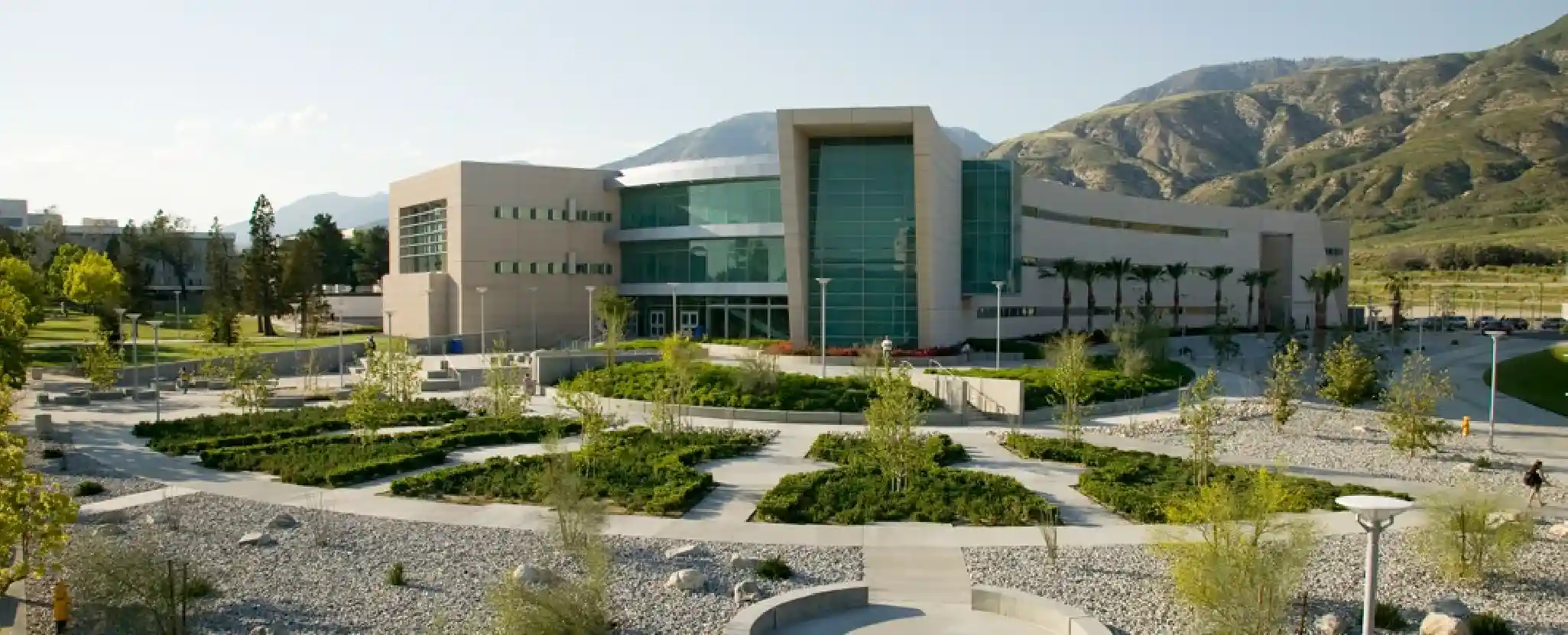
CSUSB’s main campus is in the northern part of San Bernardino, at the foot of the San Bernardino Mountains, about 60 miles east of downtown Los Angeles. Its Palm Desert Campus in the Coachella Valley serves students in the desert communities of Riverside County. In Fall 2024, 2,138 students, or 12% of CSUSB’s enrollment, took at least one unit at Palm Desert.
Programs CSUSB Is Known For
CSUSB is known for business and public administration, criminal justice, nursing, psychology, education and cybersecurity. It’s a Hispanic-Serving Institution, which means Hispanic students make up at least a quarter of full-time undergraduates and the university qualifies for federal grants to support them. Most CSUSB undergraduates are Hispanic, and many are the first in their families to attend college.
The CSUSB Coyotes compete in NCAA Division II in the California Collegiate Athletic Association.
Frequently Asked Questions
What is the CSU San Bernardino acceptance rate?
CSUSB admitted 94.3% of first-year applicants for Fall 2025, or 14,095 of 14,947, according to its Common Data Set.
Is CSU San Bernardino part of the UC system?
No. CSUSB is part of the California State University system, which has its own application and lower tuition than the University of California.
How much does CSUSB cost?
For 2026-27, California residents pay $9,348 in tuition and campus fees. The full cost of attendance is $30,154 in university housing.
What does it mean that CSUSB is a Hispanic-Serving Institution?
It means at least 25% of full-time undergraduates are Hispanic, which qualifies CSUSB for federal grants that fund student support programs open to all students.
Where is CSU San Bernardino located?
CSUSB’s main campus is in San Bernardino, California, about 60 miles east of Los Angeles, with a second campus in Palm Desert.
Should You Apply to CSUSB?
CSU San Bernardino is an accessible Cal State campus in the Inland Empire. It serves a largely local, first-generation student body at CSU prices.
For California residents, plan for $9,348 in tuition and fees, and about $25,400 a year if you commute. Compare CSUSB with UC Riverside, California Baptist University, Cal Poly Pomona and other Cal State campuses.
Sources
- CSU San Bernardino Office of Institutional Research. “Common Data Set 2025-26.” csusb.edu.
- CSUSB Office of Financial Aid and Scholarships. “Cost of Attendance.” csusb.edu.
- CSU San Bernardino. “Facts and Stats, Fall 2024.” csusb.edu.
- CSU San Bernardino. “First-Year Student Impaction.” csusb.edu.
- Wikipedia. “California State University, San Bernardino.” Wikipedia.org.

CalChannel Editorial Team California college guides
The CalChannel editorial team researches and writes guides to California colleges, admissions and financial aid. We build our college profiles and aid guides from colleges’ own published data, federal IPEDS data and the California Student Aid Commission. Read our editorial policy.