
Private colleges in California · By CalChannel Editorial Team · Updated October 5, 2026
The Pepperdine acceptance rate was 69.4% for Fall 2025: Pepperdine University admitted 9,331 of 13,445 first-year applicants, according to its Common Data Set. It’s a private Christian university in Malibu affiliated with the Churches of Christ. For new undergraduates in 2026-27, Pepperdine’s cost of attendance is $99,258 living on campus, including $74,370 in flat-rate tuition.
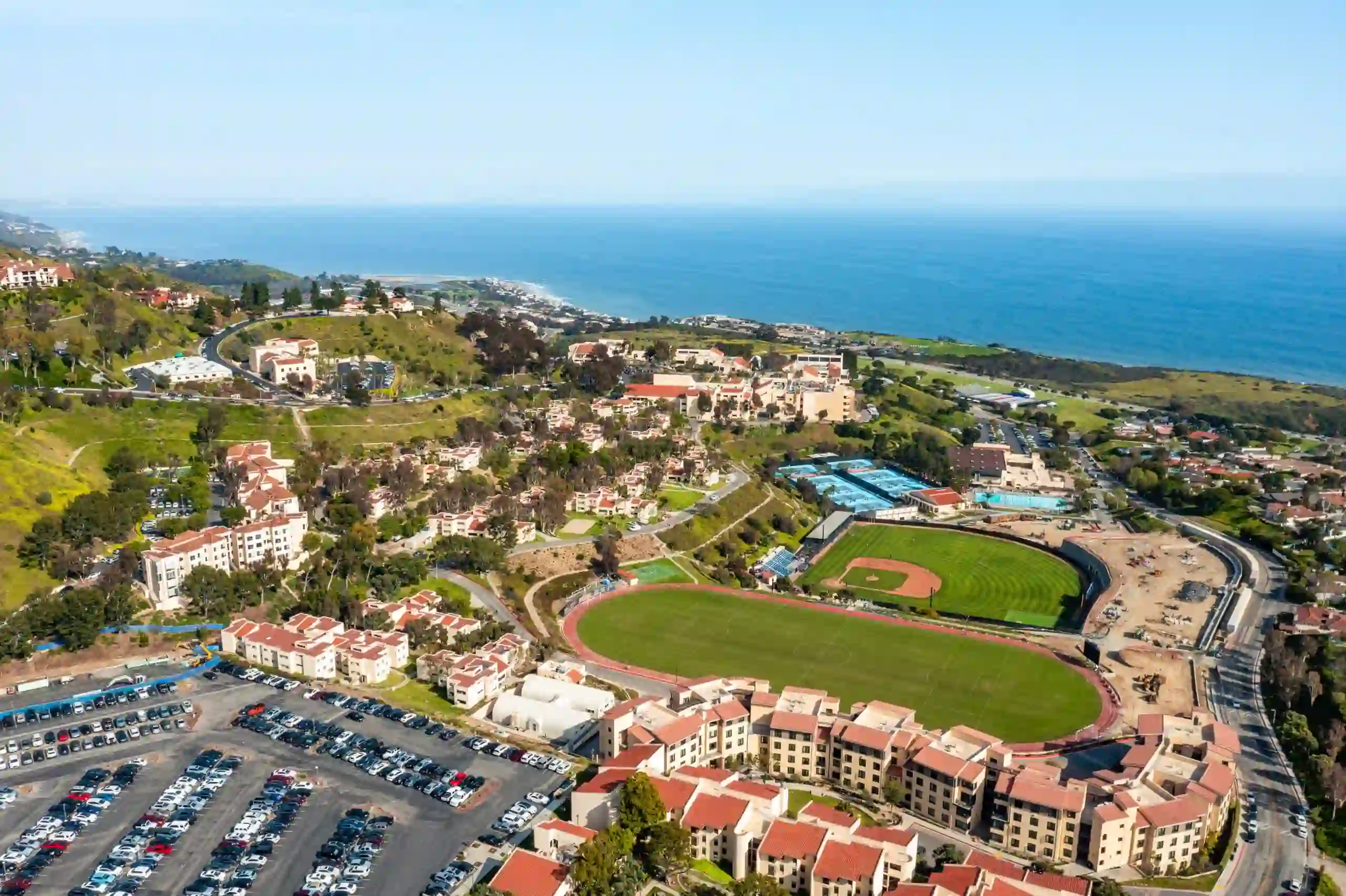
Pepperdine University is known for its hillside campus above the Pacific Ocean in Malibu, its business and communication programs, and one of the strongest study abroad programs in the country. It combines a residential undergraduate college with graduate schools of law, business, education and public policy.
Pepperdine is easier to get into than its reputation suggests, but it’s one of the most expensive universities in California. This guide uses Pepperdine’s own 2025-26 Common Data Set and 2026-27 budget to show where your odds are strongest, including its unusually generous waitlist, and what the price looks like before aid.
| Fact | Pepperdine University |
|---|---|
| Type | Private Christian university, affiliated with the Churches of Christ |
| Location | Malibu, overlooking the Pacific Ocean |
| Founded | 1937 in Los Angeles; Malibu campus opened in 1972 |
| Acceptance rate | 69.4% (Fall 2025: 9,331 admitted of 13,445 applicants) |
| Average high school GPA | 3.57 (Fall 2025 enrolled first-years) |
| SAT/ACT | Test-optional; middle 50% SAT 1240-1410, ACT 28-32 for those who submitted |
| Students | 8,726 total, 3,459 undergraduates (Fall 2025) |
| Tuition (2026-27) | $74,370 flat rate for 12-18 units per semester |
| Cost of attendance (2026-27) | $99,258 on campus; $102,288 off campus |
| Retention / graduation rate | 83% / 78% in six years (2019 cohort) |
| Student-to-faculty ratio | 12:1 |
| Athletics | Waves, NCAA Division I, West Coast Conference |
Sources: Pepperdine Common Data Set 2025-26; Pepperdine Undergraduate Admission, Tuition, Budget and Cost 2026-27. Full list at the end of the article.
In This Article
- Pepperdine University: Christian, Private, in Malibu
- Pepperdine Acceptance Rate and Its Generous Waitlist
- Applying to Pepperdine: Tests, Early Rounds and Scholarships
- Pepperdine Cost: Sticker Price vs. What Families Pay
- Undergraduates, Retention and Graduation
- The Malibu Campus and Study Abroad Sites
- Study Abroad, Business and Campus Culture
- Frequently Asked Questions
Pepperdine University: Christian, Private, in Malibu
Pepperdine University is a private Christian university founded in 1937 by businessman George Pepperdine and affiliated with the Churches of Christ. It began in South Los Angeles and moved its undergraduate college to Malibu in 1972.
Undergraduates study at Seaver College, Pepperdine’s liberal arts college, which offers majors in business, communication, the sciences, humanities, social sciences and the fine arts. The university also includes the Graziadio Business School, the Caruso School of Law, the Graduate School of Education and Psychology, and the School of Public Policy. Students of any faith, or none, can attend, and undergraduates take required religion courses and attend convocation.

Pepperdine Acceptance Rate and Its Generous Waitlist
Pepperdine admitted 69.4% of first-year applicants for Fall 2025: 13,445 students applied, 9,331 were admitted and 999 enrolled, according to its Common Data Set 2025-26.
| Pepperdine, Fall 2025 | Applied | Admitted | Acceptance rate | Enrolled |
|---|---|---|---|---|
| First-year applicants | 13,445 | 9,331 | 69.4% | 999 |
| Transfer applicants | 842 | 466 | 55.3% | 133 |
Source: Pepperdine Common Data Set 2025-26, items C1 and D2.
Pepperdine also uses a waitlist. For Fall 2025, 1,303 students were offered a spot, 812 accepted one and 670 were admitted from it, so students on Pepperdine’s waitlist had good odds.
Applying to Pepperdine: Tests, Early Rounds and Scholarships
Pepperdine uses a holistic review of grades, course rigor, essays, recommendations and activities. Enrolled first-years for Fall 2025 averaged a 3.57 high school GPA. A 69% Pepperdine acceptance rate makes it more reachable than USC or Loyola Marymount.
- Application: the Common Application with Pepperdine’s supplemental essays
- Testing: test-optional; applicants receive the same consideration with or without scores, but SAT or ACT scores are required for Regents Scholars Program scholarship consideration
- Scores, if you send them: the middle 50% of Fall 2025 submitters scored 1240-1410 on the SAT and 28-32 on the ACT; 17% of enrolled first-years submitted SAT scores and 8% submitted ACT scores
- Early rounds: nonbinding Early Action and, starting with applicants for Fall 2026, binding Early Decision, both with a November 1 deadline and a January 10 notification date, according to Pepperdine’s Common Data Set; check the current cycle’s dates on the admission website
- Transfers: Pepperdine admitted 466 of 842 transfer applicants for Fall 2025
Pepperdine Cost: Sticker Price vs. What Families Pay
Pepperdine’s 2026-27 cost of attendance for new undergraduates is $99,258 living on campus and $102,288 living off campus. Tuition is a flat $74,370 for 12 to 18 units per semester.
| Pepperdine cost of attendance, 2026-27 | On campus | Off campus |
|---|---|---|
| Flat-rate tuition (12-18 units per semester) | $74,370 | $74,370 |
| Housing and food | $20,490 | $23,020 |
| Wellness fee | $580 | $580 |
| Campus life fee | $252 | $252 |
| Loan fees | $66 | $66 |
| Books and supplies | $1,000 | $1,000 |
| Transportation | $1,000 | $1,500 |
| Personal expenses | $1,500 | $1,500 |
| Total | $99,258 | $102,288 |
Source: Pepperdine Undergraduate Admission, Undergraduate Tuition, Budget and Cost, 2026-2027 cost of attendance for new students.
Federal College Navigator data show an average net price of $66,585 for first-time, full-time students receiving grant aid at Pepperdine in 2023-24, higher than at Santa Clara, Chapman, Occidental or USF, so compare aid offers carefully.
Most students don’t pay the full price. Pepperdine offers merit scholarships and need-based grants, and California residents can use a Cal Grant at Pepperdine. File the FAFSA and the CSS Profile, and use Pepperdine’s net price calculator to estimate your own cost.
Our take: Pepperdine’s cost of attendance is close to $100,000 a year, one of the highest in California, and living off campus in Malibu costs even more than living on campus. Families should compare aid offers carefully, and students who want scholarship consideration through the Regents Scholars Program should submit test scores even though admission is test-optional.
Undergraduates, Retention and Graduation
Pepperdine had 8,726 students in Fall 2025, including 3,459 undergraduates and 5,267 graduate and professional students, according to its Common Data Set. The undergraduate college is small, with a student-to-faculty ratio of 12:1.
About 83% of first-year students returned for their second year. Of the 2019 entering class, 67% graduated in four years and 78% within six years.
The Malibu Campus and Study Abroad Sites
Pepperdine’s main campus is in Malibu, on hills overlooking the Pacific Ocean along Pacific Coast Highway, about 30 miles west of downtown Los Angeles. The campus covers more than 800 acres and is often ranked among the most beautiful college campuses in the country.
Pepperdine also runs graduate campuses in the Los Angeles area and international programs in cities such as Buenos Aires, Florence, Heidelberg, Lausanne, London and Shanghai.
Study Abroad, Business and Campus Culture
Pepperdine is known for its international programs, which send a large share of undergraduates to study abroad at Pepperdine-owned residences overseas. It’s also known for business, communication, sports medicine and political science, and for a campus culture shaped by its Christian mission.
The Pepperdine Waves compete in NCAA Division I in the West Coast Conference, with strong programs in volleyball, water polo, tennis and golf.
Frequently Asked Questions
What is the Pepperdine acceptance rate?
Pepperdine admitted 69.4% of first-year applicants for Fall 2025, or 9,331 of 13,445, according to its Common Data Set.
How much does Pepperdine cost per year?
Pepperdine’s 2026-27 cost of attendance for new undergraduates is $99,258 on campus and $102,288 off campus, including $74,370 in tuition.
Do you have to be Christian to attend Pepperdine?
No. Pepperdine is affiliated with the Churches of Christ, but students of all faiths and backgrounds can attend. Undergraduates take required religion courses and attend convocation.
What are the chances of getting off Pepperdine’s waitlist?
For Fall 2025, 812 students accepted a place on Pepperdine’s waitlist and 670 were admitted from it, about 83%.
Does Pepperdine require the SAT or ACT?
No. Pepperdine is test-optional, but scores are required to be considered for the Regents Scholars Program scholarships.
Where is Pepperdine University located?
Pepperdine’s main campus is in Malibu, California, overlooking the Pacific Ocean, about 30 miles west of downtown Los Angeles.
Is Pepperdine Right for You?
Pepperdine University is a private Christian university in Malibu. It offers a small undergraduate college, a striking coastal campus and extensive study abroad, with a 12:1 student-to-faculty ratio. Compare Pepperdine with Loyola Marymount, University of the Pacific and other private colleges in California.
Its 2026-27 cost of attendance is $99,258 on campus before aid, so compare net price offers carefully. If you’re also considering a larger Los Angeles university, see how Pepperdine compares with USC.
Sources
- Pepperdine Office of Institutional Effectiveness. “Common Data Set 2025-26.” pepperdine.edu.
- Pepperdine Undergraduate Admission. “Undergraduate Tuition, Budget, and Cost.” pepperdine.edu.
- National Center for Education Statistics. “College Navigator: Pepperdine University.”
- Wikipedia. “Pepperdine University.” Wikipedia.org.

CalChannel Editorial Team California college guides
The CalChannel editorial team researches and writes guides to California colleges, admissions and financial aid. We build our college profiles and aid guides from colleges’ own published data, federal IPEDS data and the California Student Aid Commission. Read our editorial policy.