
Private colleges guide · By CalChannel Editorial Team · Updated September 29, 2026
The Harvey Mudd acceptance rate was 12% for Fall 2025: Harvey Mudd College admitted 643 of 5,217 first-year applicants, according to its Common Data Set. Score submitters had a middle 50% SAT of 1500 to 1560. The 2026-27 cost of attendance is $104,512, but Mudd meets 100% of demonstrated need, and the average need-based grant was $58,910.
Harvey Mudd is one of the smallest colleges in California and one of the hardest to get into. It’s also one of the most expensive on paper, which is why “why is Harvey Mudd so expensive” is a common question right after “what’s the acceptance rate.”
Both questions have better answers than the headline numbers suggest. Here’s who gets in, what families actually pay, and what you get for it.
| Fact | Harvey Mudd College |
|---|---|
| Type | Private liberal arts college focused on science, engineering and math |
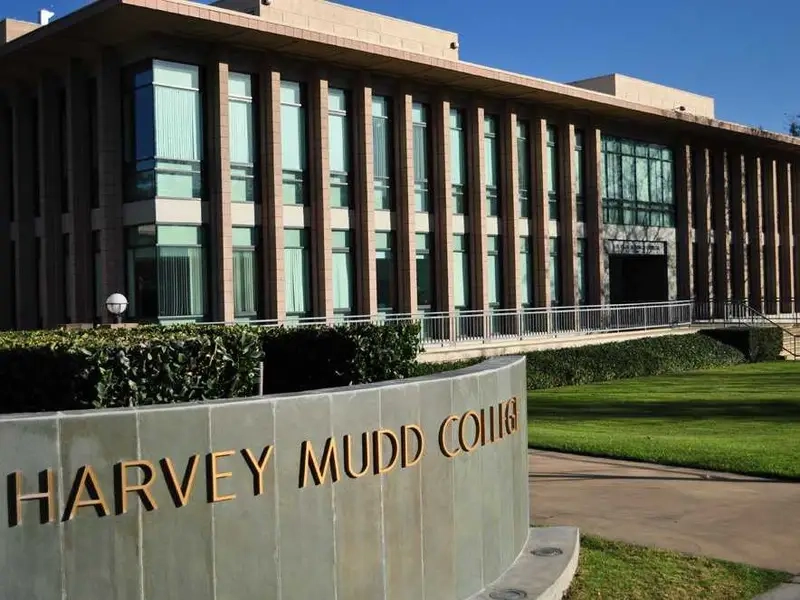
| Location | 301 Platt Blvd., Claremont, California (member of the Claremont Colleges) |
| Founded | 1955 |
| Acceptance rate | 12% (Fall 2025: 643 admitted of 5,217 applicants) |
| Early Decision acceptance rate | 18% (Fall 2025: 109 of 594) |
| Middle 50% SAT / ACT (score submitters) | 1500–1560 / 35–36 |
| Test policy | SAT/ACT optional through 2027 |
| Students | 913 undergraduates (Fall 2025) |
| Student-to-faculty ratio | 8:1 |
| Cost of attendance, on campus (2026-27) | $104,512 |
| Financial aid | Meets 100% of demonstrated need; average need-based grant $58,910 |
| Retention / six-year graduation rate | 95% / 93% (2019 cohort) |
| U.S. News 2026 | #10 National Liberal Arts (tie); #2 Engineering, non-doctorate |
Sources: Harvey Mudd Common Data Set 2025-26; Harvey Mudd Cost of Attendance 2026-27; Harvey Mudd News. Full list at the end of the article.
In This Article
- Harvey Mudd in Brief: A STEM College in Claremont
- Claremont and the 5C Consortium
- Harvey Mudd Acceptance Rate and Who Gets In
- What Is the Harvey Mudd FAST Program?
- How Much Does Harvey Mudd Cost, and Why Is It So Expensive?
- Class Size, Retention and Graduation at Mudd
- Harvey Mudd Rankings
- Academics and Outcomes Harvey Mudd Is Known For
- Frequently Asked Questions
Harvey Mudd in Brief: A STEM College in Claremont
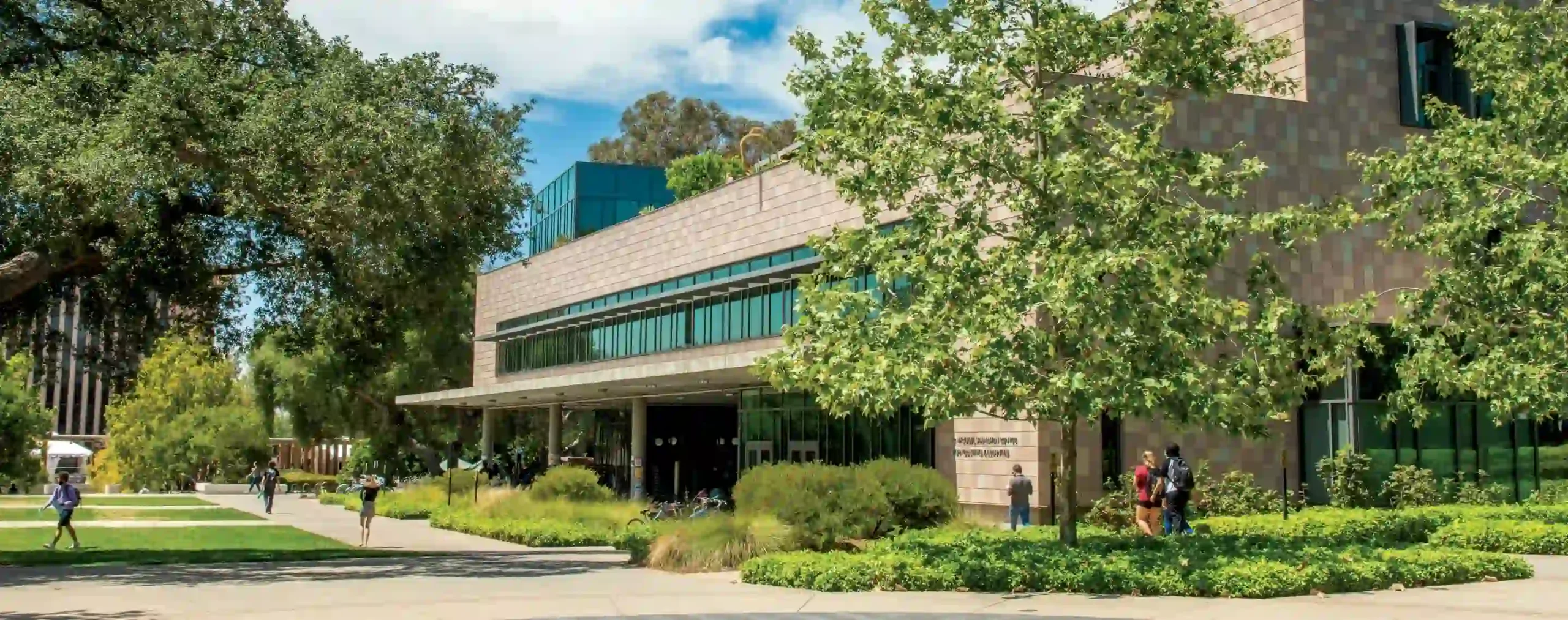
Harvey Mudd College is a private liberal arts college in Claremont, California, founded in 1955 and built around science, engineering and mathematics. It offers majors in biology, chemistry, computer science, engineering, mathematics and physics, plus joint majors such as computer science and mathematics or chemistry and biology.
What makes Mudd different from a technical institute is its Common Core: every student, regardless of major, completes a shared curriculum in math, the sciences, computing and engineering, alongside substantial coursework in the humanities, social sciences and the arts. The idea is to train scientists and engineers who also understand the social impact of their work.
- Type: private, nonprofit, undergraduate-only
- Founded: 1955
- Majors: biology, chemistry, computer science, engineering, mathematics, physics and joint majors
- Consortium: one of the Claremont Colleges
- Athletics: NCAA Division III as part of Claremont-Mudd-Scripps (Stags and Athenas)
Claremont and the 5C Consortium
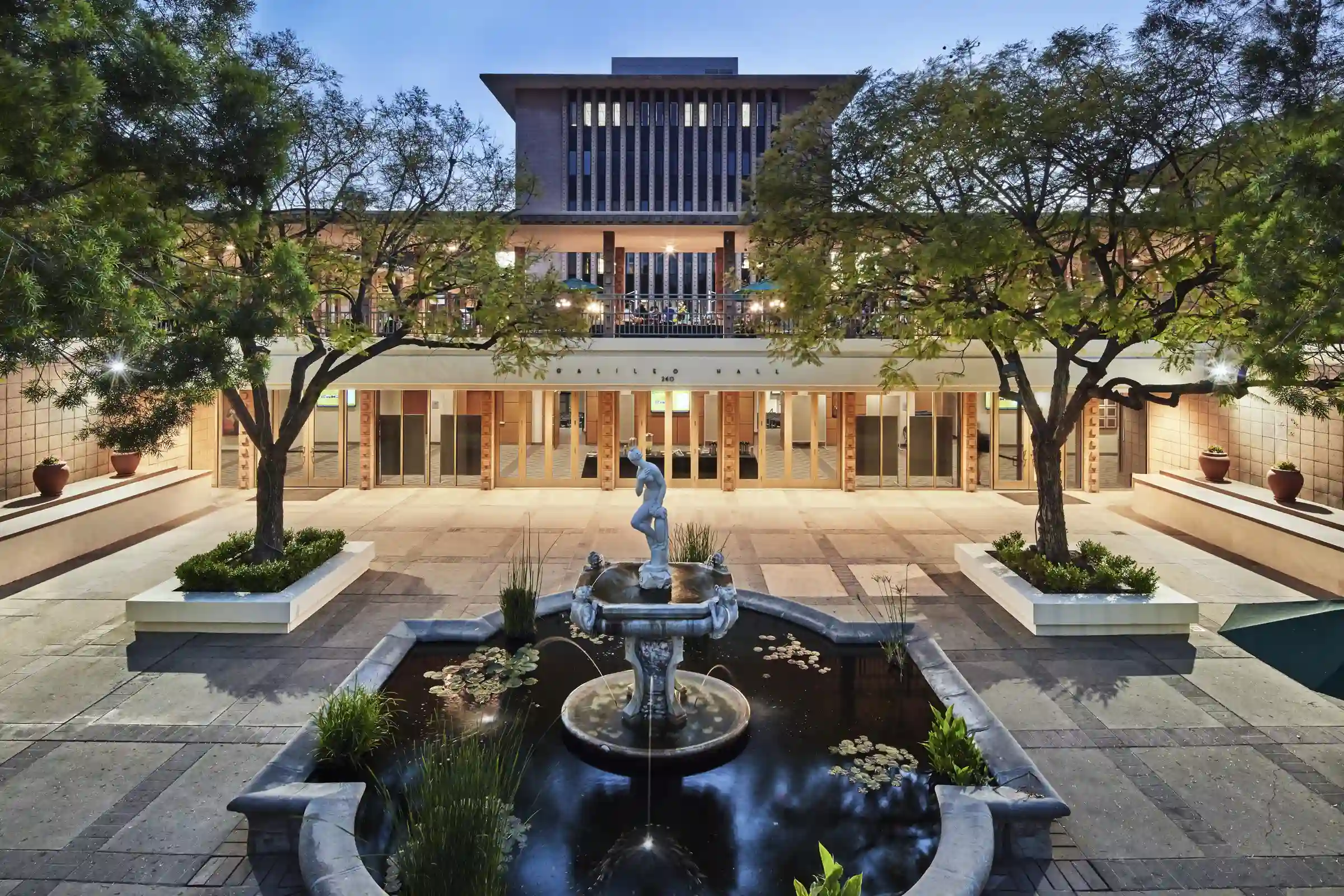
Harvey Mudd College is at 301 Platt Blvd. in Claremont, California, about 35 miles east of downtown Los Angeles at the foot of the San Gabriel Mountains. Its compact 38-acre campus is part of the Claremont Colleges, a consortium of five undergraduate colleges (Pomona, Claremont McKenna, Scripps, Pitzer and Harvey Mudd) and two graduate institutions that sit next to one another.
That setup is Mudd’s quiet advantage. Students get the attention of a school with fewer than 1,000 undergraduates, but they can cross-register for courses, eat in dining halls and join clubs across all the Claremont Colleges.
Harvey Mudd Acceptance Rate and Who Gets In
The Harvey Mudd acceptance rate was about 12% for Fall 2025: Harvey Mudd College admitted 643 of 5,217 first-year applicants, and 236 enrolled, according to its Common Data Set 2025-26. Applications keep growing, while the number of admitted students has stayed between roughly 470 and 650 a year.
| Admissions year | Applicants | Admitted | Acceptance rate | Enrolled |
|---|---|---|---|---|
| Fall 2025 | 5,217 | 643 | 12.3% | 236 |
| 2024-25 | 5,094 | 645 | 12.7% | 231 |
| 2023-24 | 4,792 | 626 | 13.1% | 224 |
| 2022-23 | 4,440 | 593 | 13.4% | 237 |
| 2021-22 | 4,737 | 474 | 10.0% | 227 |
| 2020-21 | 3,397 | 610 | 18.0% | 209 |
Sources: Fall 2025 from the Harvey Mudd Common Data Set 2025-26; earlier years from IPEDS data via CollegeTuitionCompare.
Here’s what the number hides: the applicant pool is heavily self-selected. Among enrolled students who submitted scores for Fall 2025, the middle 50% SAT range was 1500 to 1560 and the ACT range was 35 to 36, and 98% of SAT submitters scored 1400 or higher. Most applicants are strong in math and science, so the real competition is sharper than 12% suggests.
Residency changes the odds too. For Fall 2025, Mudd admitted about 12% of California applicants (283 of 2,291), about 18% of applicants from other states (291 of 1,631) and about 5% of international applicants (69 of 1,295).
Early Decision at Harvey Mudd
Early Decision gives a measurable edge. For Fall 2025, Harvey Mudd admitted 109 of 594 Early Decision applicants, about 18%, compared with about 12% overall. Early Decision is binding, so it only makes sense if Mudd is your clear first choice and you’ve checked the cost with the net price calculator.
- Early Decision I: apply by November 15, decision by December 15
- Early Decision II: apply by January 5, decision by February 15
- Regular Decision: apply by January 5, decision by April 1
- Testing: SAT/ACT optional through 2027; applicants who don’t submit scores are not at a disadvantage
- Financial aid: CSS Profile and FAFSA, with deadlines tied to your decision plan
What Is the Harvey Mudd FAST Program?
FAST (Future Achievers in Science and Technology) is a free, overnight fly-in program for high-achieving high school seniors interested in STEM. It is not an admissions program, and Harvey Mudd states that FAST results have no effect on your first-year application. Participants do receive a fee waiver for the application.
That’s why the “Harvey Mudd FAST acceptance rate” is hard to pin down: the college doesn’t publish one. It does say each FAST session hosts around 40 to 50 students and that many qualified applicants are turned away because of space and budget limits. For students entering in fall 2027, the sessions ran September 13 to 15 and October 25 to 27, 2026, and applications closed August 9, 2026.
- Who can apply: U.S. citizens and permanent residents living in the U.S. who are high school seniors
- What you submit: activities and honors, an essay and an unofficial transcript
- What it covers: travel, lodging and meals for an overnight campus visit with classes, labs and dorm stays
How Much Does Harvey Mudd Cost, and Why Is It So Expensive?
Harvey Mudd tuition for 2026-27 is $76,879, and the full cost of attendance is $104,512 for students living on campus, including $13,293 for housing and $11,489 for a full meal plan. Students living off campus have a budget of $90,912, and those living with family $83,793.
| Cost component (2026-27) | On campus | Off campus | With family |
|---|---|---|---|
| Tuition | $76,879 | $76,879 | $76,879 |
| Student body fee | $401 | $401 | $401 |
| Housing | $13,293 | $7,546 | $4,063 (housing and food combined) |
| Food | $11,489 | $3,636 | Included above |
| Books and supplies | $800 | $800 | $800 |
| Personal expenses | $1,400 | $1,400 | $1,400 |
| New student orientation fee | $250 | $250 | $250 |
| Total cost of attendance | $104,512 | $90,912 | $83,793 |
Source: Harvey Mudd College, Cost of Attendance 2026-2027. Transportation varies by distance and is not included.
So why is Harvey Mudd so expensive? Three reasons. It’s tiny, so fixed costs are spread across fewer than 1,000 students. It’s lab- and project-heavy, with an 8:1 student-to-faculty ratio and a capstone Clinic program that puts student teams on real industry projects. And unlike public universities, it receives no state subsidy, so tuition carries most of the cost of instruction.
But the sticker price isn’t what most families pay. Harvey Mudd meets 100% of demonstrated financial need, and according to its Common Data Set 2025-26, the average need-based grant was $58,910 for full-time undergraduates and $64,941 for first-year students. Federal data put the average net price at $43,966 in 2023-24 for students receiving grant aid. Graduates who borrowed left with an average of $30,350 in debt.
Our take: Harvey Mudd is a case where the sticker price and the real price can be tens of thousands of dollars apart. A school that meets full need looks at your family’s finances and builds the package to close the gap, mostly with grants. That makes the net price calculator and the CSS Profile more important than the $104,512 headline. The families who get surprised are usually the ones who never ran the numbers.
There’s also the return side. Harvey Mudd reports a median starting salary of $102,500 for the Class of 2026, with 59.5% of graduates in full-time jobs and 22.5% heading to graduate or professional school. PayScale ranked Mudd first in the nation for return on investment in 2024.
Class Size, Retention and Graduation at Mudd
Harvey Mudd had 913 undergraduate students in Fall 2025 and no graduate programs, with a student body that is 51% female and 49% male. The student-to-faculty ratio is 8:1, and the college has about 110 instructional faculty.
Harvey Mudd Class Size
Classes are small by design. In the 2023-24 Common Data Set, 149 of 248 undergraduate class sections, or 60%, had fewer than 20 students, and 69 sections had fewer than 10. Introductory Core courses can be larger, but upper-level major courses, labs and Clinic teams of 4 to 5 students keep most of your time in small groups.
Students also persist. About 95% of first-year students return for their second year, and 93% of the 2019 entering class graduated within six years.
Harvey Mudd Rankings
Harvey Mudd tied for No. 10 among national liberal arts colleges in the U.S. News 2026 Best Colleges, its first time in the top 10, and ranked No. 2 for undergraduate engineering among schools that don’t grant doctorates. Its computer science program ranked No. 25 overall, the highest of any undergraduate-only college on that list.
| Ranking (U.S. News 2026) | Harvey Mudd |
|---|---|
| National Liberal Arts Colleges | #10 (tie) |
| Undergraduate Engineering, non-doctorate | #2 |
| Mechanical Engineering, non-doctorate | #3 |
| Electrical Engineering, non-doctorate | #4 |
| Computer Engineering, non-doctorate | #4 (tie) |
| Computer Science | #25 |
| Most Innovative Schools, liberal arts | #13 |
| Undergraduate Research, liberal arts | #14 |
Source: Harvey Mudd College News, “Harvey Mudd Among Top Colleges in U.S. News 2026 Rankings.”
Academics and Outcomes Harvey Mudd Is Known For
Harvey Mudd is best known for three things: its Common Core curriculum, its Clinic Program and graduates who move into top engineering, tech and research roles.
The Clinic Program is the one people outside Claremont hear about. Running for more than 60 years, it puts teams of 4 to 5 juniors and seniors on real technical problems for sponsoring companies and organizations. Clinic has worked with 626 sponsors on 2,032 projects, including Amazon, Google, NASA, Microsoft and Lawrence Livermore National Laboratory.
Is Harvey Mudd a good engineering school? By the numbers, yes: No. 2 among non-doctoral engineering programs, a general engineering major built on the Core, and Clinic experience that works like a year of professional practice before graduation. If you’re comparing it with a research university, see our guide to Caltech, the other small, highly selective STEM school in the Los Angeles area, or browse our private colleges guide.
Frequently Asked Questions
What is the Harvey Mudd acceptance rate?
Harvey Mudd admitted about 12% of first-year applicants for Fall 2025, or 643 of 5,217, according to its Common Data Set. Early Decision applicants were admitted at about 18%.
Is Harvey Mudd test optional?
Yes. Harvey Mudd has extended its SAT/ACT optional pilot through 2027, and applicants who don’t submit scores are not at a disadvantage. Among Fall 2025 enrollees who submitted, the middle 50% SAT range was 1500 to 1560.
Does the FAST program help you get into Harvey Mudd?
Not directly. Harvey Mudd says FAST results have no effect on your first-year application. FAST participants do receive an application fee waiver and get to know the college before applying.
Is Harvey Mudd a good engineering school?
Yes. U.S. News 2026 ranks Harvey Mudd No. 2 for undergraduate engineering among schools without doctoral programs, with No. 3 in mechanical and No. 4 in electrical and computer engineering. Engineering students also take part in the Clinic Program, working on real industry projects.
How is Harvey Mudd different from Pomona College?
Both are Claremont Colleges, but Harvey Mudd focuses on science, engineering and math with a required technical Core, while Pomona is a liberal arts college across all fields. Students at each can take classes at the other.
Do Harvey Mudd students only take STEM classes?
No. The Common Core includes substantial coursework in the humanities, social sciences and the arts, and students can take those courses across the Claremont Colleges.
Who Thrives at Harvey Mudd?
Harvey Mudd College is a 913-student STEM college with a 12% acceptance rate for Fall 2025, an 8:1 student-to-faculty ratio, top-10 liberal arts status and the No. 2 undergraduate engineering program among non-doctoral schools. Admission is highly selective, and Early Decision offers a modest edge for students sure Mudd is their first choice.
On cost, don’t stop at $104,512. Mudd meets full demonstrated need, and its average need-based grant is close to $59,000. Run the net price calculator, file the CSS Profile and FAFSA on time, and compare the result with offers from other top STEM schools. You can also compare private options elsewhere in Southern California, such as Loyola Marymount University.
Sources
- Harvey Mudd College Institutional Research. “Common Data Set 2025-2026” and “Common Data Set 2023-2024.” hmc.edu.
- Harvey Mudd College. “Fast Facts.” hmc.edu.
- Harvey Mudd College. “Cost of Attendance, 2026-2027.” hmc.edu.
- Harvey Mudd College. “Apply to Harvey Mudd.” hmc.edu.
- Harvey Mudd College. “Future Achievers in Science and Technology (FAST).” hmc.edu.
- Harvey Mudd College News. “Harvey Mudd Among Top Colleges in U.S. News 2026 Rankings.” September 23, 2025.
- Harvey Mudd College. “Clinic Program.” hmc.edu.
- CollegeTuitionCompare. “Harvey Mudd College Admission Trends.” Based on IPEDS data.
- National Center for Education Statistics. “College Navigator: Harvey Mudd College.”
- Wikipedia. “Harvey Mudd College.” Wikipedia.org.

CalChannel Editorial Team California college guides
The CalChannel editorial team researches and writes guides to California colleges, admissions and financial aid. We build our college profiles and aid guides from colleges’ own published data, federal IPEDS data and the California Student Aid Commission. Read our editorial policy.