Private colleges guide · By CalChannel Editorial Team · Updated September 29, 2026
The LMU acceptance rate was 48% for Fall 2025: Loyola Marymount University admitted 10,992 of 22,798 first-year applicants, according to its Common Data Set. LMU is a private Jesuit university in Los Angeles and is test-optional. Tuition is $68,042 for 2026-27, and the on-campus cost of attendance is $99,289 before financial aid.
Looking for Lincoln Memorial University? This guide covers Loyola Marymount University in Los Angeles, California. Lincoln Memorial University, also called LMU, is a separate private university in Harrogate, Tennessee.
Loyola Marymount sits in an unusual spot among California private universities. It’s well known in Los Angeles, respected in film, business and law, and still underrated by families outside Southern California. It’s also expensive, and the gap between its published price and what students actually pay is the part most guides skip.
So here’s the practical version: who gets in, what it costs before and after aid, how large the student body is, and whether LMU belongs on your list.
| Fact | Loyola Marymount University |
|---|---|
| Type | Private, nonprofit, Catholic (Jesuit and Marymount traditions) |
| Location | Westchester, Los Angeles, California |
| Acceptance rate | 48% (Fall 2025: 10,992 admitted of 22,798 applicants) |
| Test policy | Test-optional (SAT/ACT not required) |
| Middle 50% SAT / ACT (score submitters) | 1265–1410 / 28–33 |
| High school GPA | 50% of enrolled first-years had a 4.0 (Fall 2025) |
| Total students | 10,062 (7,187 undergraduates, Fall 2025) |
| Undergraduate tuition (2026-27) | $68,042 ($68,939 with fees) |
| Cost of attendance, on campus (2026-27) | $99,289 |
| Average need-based aid package (Fall 2025) | $43,037 for full-time undergraduates with need |
| Six-year graduation rate | 78.8% (2019 cohort) |
| Student-to-faculty ratio | 10:1 |
| U.S. News 2026, National Universities | #102 (tie) |
Sources: LMU Common Data Set 2025-26; LMU Financial Aid, Undergraduate Cost of Attendance 2026-27; LMU Newsroom; LMU Facts & Figures. Full list at the end of the article.
In This Article
Loyola Marymount University in Brief
LMU is Loyola Marymount University, a private Catholic university in Los Angeles. To answer the common question directly: yes, LMU is a private school. It is not part of the University of California or Cal State systems, so there is no lower in-state tuition for California residents. Every student pays the same published price, and aid comes mostly from the university itself.
The name comes from two schools that merged. The Jesuits founded Los Angeles College in 1911, and the institution traces its roots even further back, to St. Vincent’s College, opened in 1865. It settled on its current Westchester bluff around 1930, on land donated by developer Harry Culver. Marymount College, run by the Religious of the Sacred Heart of Mary, joined it on that campus and the two formally merged in 1973. Today LMU is co-sponsored by the Jesuits, the Religious of the Sacred Heart of Mary and the Sisters of St. Joseph of Orange.
That Jesuit identity shapes how the school runs day to day: small classes, a core curriculum that pushes students across disciplines, and a strong emphasis on ethics and service.
- Founded: 1911 (merged with Marymount College in 1973)
- Research classification: High Research Activity (R2)
- Campuses: Westchester (main), Playa Vista (film and television) and Loyola Law School in downtown Los Angeles
- Average undergraduate class: 20 students
- Athletics: NCAA Division I, West Coast Conference
- Mascot: the Lions
LMU’s Westchester Campus
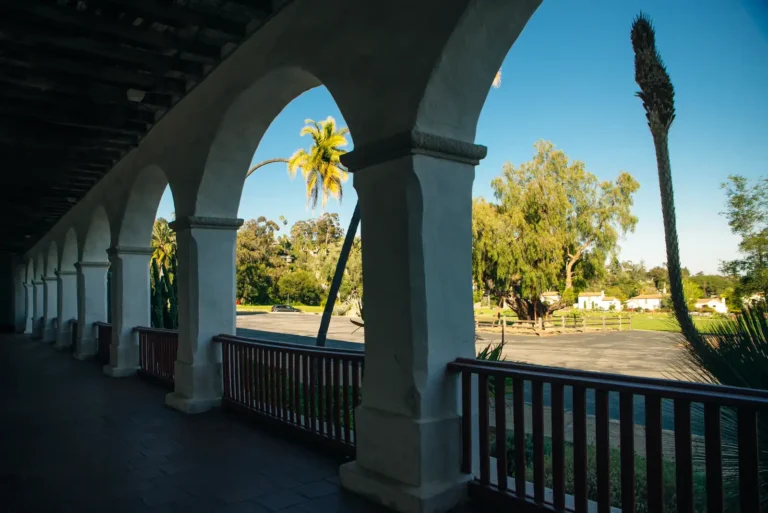
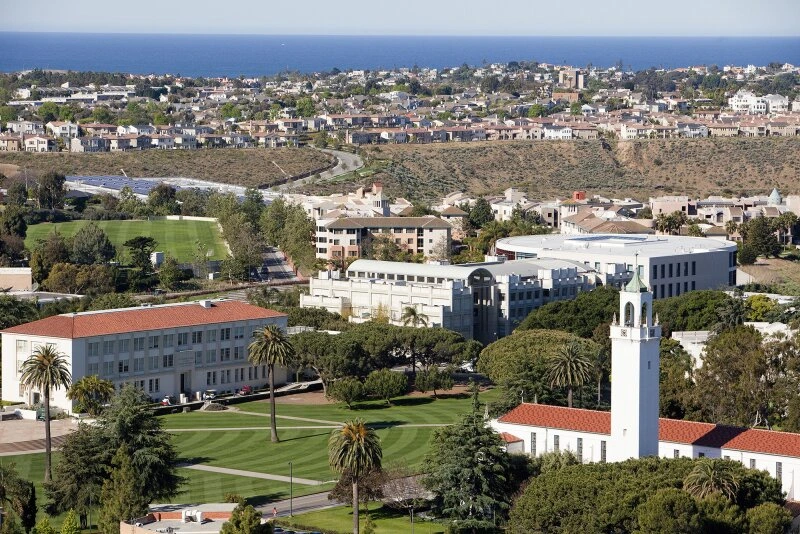
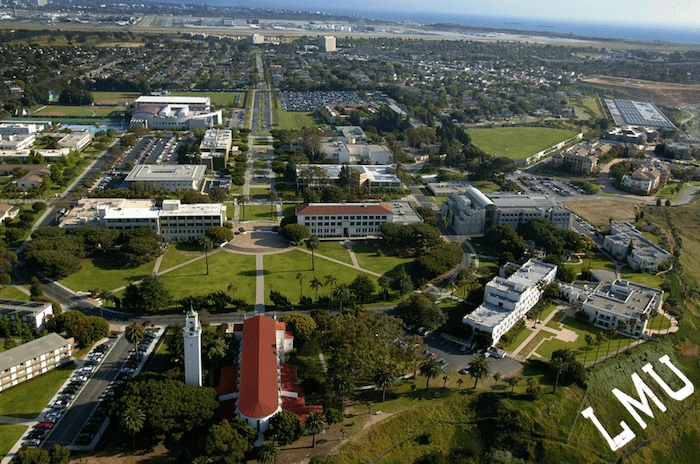
LMU is in Westchester, a neighborhood on the west side of Los Angeles near LAX. The roughly 150-acre main campus sits on a bluff above Playa del Rey, with views of the Pacific Ocean on clear days. It’s one of the few urban campuses in Los Angeles that still feels like a self-contained college campus.
The location matters for more than the view. The Playa Vista campus, home to much of the School of Film and Television’s production space, sits in a neighborhood full of media and tech companies. Loyola Law School operates on its own campus downtown. For students aiming at entertainment, law or business careers in Los Angeles, that proximity turns into internships and networks.
How Hard Is It to Get Into LMU?
The LMU acceptance rate was 48% for Fall 2025: Loyola Marymount admitted 10,992 of 22,798 first-year applicants, and 1,536 enrolled, according to its Common Data Set 2025-26. That makes LMU selective but not ultra-selective. It is harder to get into than most colleges nationally and noticeably easier than UCLA or USC.
Here’s what the headline number hides. Applications to LMU have grown by about 70% since 2015, and the Loyola Marymount University acceptance rate has moved between 40% and 54% over that decade. The rate dipped to 40% in 2023-24 and has risen in each year since.
| Admissions year | Applicants | Admitted | Acceptance rate | Yield |
|---|---|---|---|---|
| Fall 2025 | 22,798 | 10,992 | 48.2% | 14.0% |
| 2024-25 | 23,089 | 10,409 | 45.1% | 14.8% |
| 2023-24 | 23,361 | 9,413 | 40.3% | 16.3% |
| 2022-23 | 21,695 | 8,963 | 41.3% | 17.9% |
| 2021-22 | 19,045 | 8,761 | 46.0% | 18.0% |
| 2020-21 | 18,576 | 9,314 | 50.1% | 15.8% |
| 2019-20 | 18,592 | 8,150 | 43.8% | 18.0% |
Sources: Fall 2025 from the LMU Common Data Set 2025-26; earlier years from IPEDS data via CollegeTuitionCompare.
The yield figure is worth a second look. Only about 14% of admitted students enroll, which tells you most applicants treat LMU as one option among several. For you, that means two things: LMU competes for students with aid offers, and comparing award letters side by side is worth the effort.
Residency matters less than at a public university, but the numbers still differ. For Fall 2025, LMU admitted about 55% of California applicants (6,673 of 12,133) and about 52% of applicants from other states (4,166 of 7,958). It also placed 6,148 applicants on the waitlist and admitted 208 of them.
LMU does not publish a minimum GPA and reviews applications holistically, weighing grades and course rigor alongside essays, activities and fit with its Jesuit mission. Grades are high across the board: half of enrolled first-years for Fall 2025 had a 4.0 high school GPA, and another 29% were between 3.75 and 3.99. Among students who submitted scores, the middle 50% SAT range was 1265 to 1410 and the ACT range was 28 to 33.
Is LMU Test Optional?
Yes. LMU is test-optional for first-year applicants under every application plan, so SAT and ACT scores are not required, and most enrolled students don’t send them. If your scores sit at or above the ranges above, sending them can help. If they fall well below, your transcript and essays can carry the application.
LMU Application Deadlines
- Early Decision I (binding): November 1, decision in mid-December
- Early Action (non-binding): November 1, decision in mid-December
- Early Decision II (binding): January 8, decision in mid-February
- Regular Decision: January 15, decision in early March
LMU Tuition and Total Cost
LMU tuition for undergraduates is $68,042 for 2026-27, a 5.54% increase over the prior year. With required fees, tuition and fees come to $68,939. Once housing, food, books, transportation and personal expenses are added, LMU estimates the full on-campus cost of attendance at $99,289 per year.
| Cost component (2026-27) | On campus | Off campus | With parents |
|---|---|---|---|
| Tuition and fees | $68,939 | $68,939 | $68,939 |
| Housing and food | $23,602 | $24,561 | $12,537 |
| Books and supplies | $1,305 | $1,305 | $1,305 |
| Personal and miscellaneous | $3,969 | $5,706 | $4,563 |
| Parking and transportation | $1,386 | $1,656 | $1,206 |
| Federal loan fees | $88 | $88 | $88 |
| Estimated total cost of attendance | $99,289 | $102,255 | $88,638 |
Source: LMU Financial Aid, Undergraduate Cost of Attendance 2026-2027.
But that’s the sticker price, and very few LMU students pay it. LMU runs a high-tuition, high-aid model. According to the university, 90% of undergraduates receive some form of financial aid, and LMU awarded more than $192 million in grants and scholarships, including $142 million directly to undergraduate students. For Fall 2025, full-time undergraduates with demonstrated need received an average need-based aid package of $43,037, and LMU met about 68% of their need on average, according to its Common Data Set.
Our take: With a school like LMU, the published cost of attendance is the starting point, not the bill. The number that matters is your net price: the cost of attendance minus grants and scholarships you never repay. Run LMU’s net price calculator with your real family income before you rule it in or out, then compare that figure with your offers from UC, Cal State and other private schools. Loans lower what you pay this year, not what the degree costs.
So what should a family actually expect? It depends heavily on income and on how much merit aid LMU offers. The only reliable estimate is the one from LMU’s net price calculator. For perspective on the public alternative, Cal State Long Beach charged California residents $7,350 in tuition and fees in 2024-25, a fraction of LMU’s price before aid.
LMU Enrollment and Class Sizes
LMU had 10,062 students in Fall 2025, according to its Common Data Set: 7,187 undergraduates and 2,875 graduate and law students. The LMU student population has held steady at around 10,000 for several years.
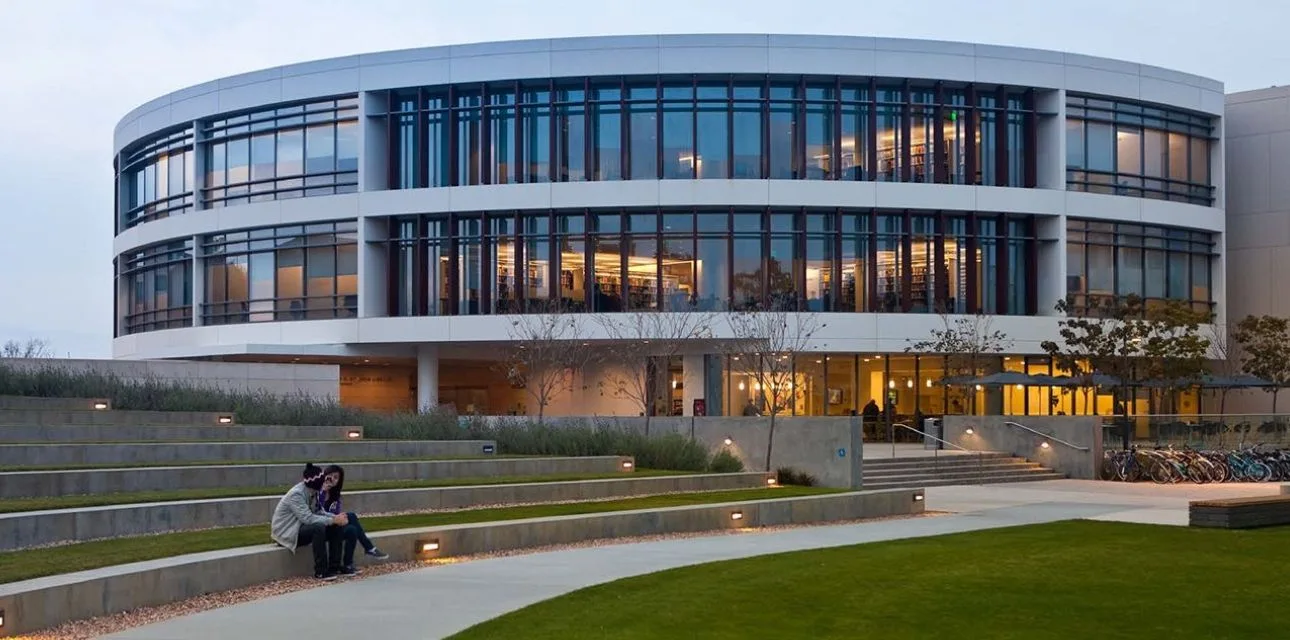
That size puts LMU in the middle range for private universities. It’s large enough to offer more than 120 majors and minors, yet small enough that the average undergraduate class has 20 students. LMU’s 20 residence halls house 3,679 students, so a large share of undergraduates live on campus.
The student body reflects Los Angeles. About 68% of students come from California and 32% from other states, and LMU enrolls more than 1,200 international students from over 100 countries. By race and ethnicity, 2024 enrollment was about 37% White, 27% Hispanic or Latino, 11% Asian, 8% Black and 8% two or more races.
LMU Rankings and Graduate Outcomes
Yes, LMU is a good school, and its outcomes show it more clearly than its overall ranking does. The student-to-faculty ratio is 10:1, about 89% of full-time first-year students return for a second year, 74% of students complete their degree within four years, and 78.8% of the 2019 entering class graduated within six. That four-year figure matters financially: every extra semester at LMU prices adds thousands to the total cost.
The overall Loyola Marymount University ranking is less flattering. In the 2026 U.S. News Best Colleges edition, LMU tied at No. 102 among national universities, down from No. 91 the year before. Program-level rankings tell a stronger story.
| Ranking source | Category | LMU |
|---|---|---|
| U.S. News (2026) | National Universities | #102 (tie) |
| U.S. News (2026) | Private University in California | #6 |
| U.S. News (2026) | Best Undergraduate Teaching | #27 |
| U.S. News (2026) | Undergraduate International Business | #10 |
| U.S. News (2026) | Undergraduate Entrepreneurship | #15 |
| U.S. News (2026) | Undergraduate Engineering | #21 |
| U.S. News (2026) | Undergraduate Marketing | #25 |
| The Wrap (2025) | Top Film Schools in the U.S. | #5 |
| The Princeton Review (2026) | Green Colleges | #4 |
| The Princeton Review (2026) | Students Most Engaged in Community Service | #17 |
| Niche (2026) | Best Catholic Universities | #13 |
Source: LMU Rankings page; U.S. News 2026 national rank reported by the Los Angeles Loyolan.
So is LMU a good school for you? If you want film and television, business, engineering or a teaching-focused experience in Los Angeles, the program rankings put it in strong company. If overall prestige is your main filter, the national ranking trend is worth knowing before you pay private-school prices.
Programs and Strengths LMU Is Known For
LMU is best known for its School of Film and Television, ranked fifth in the country by The Wrap in 2025. But the catalog is broader than most people expect: more than 120 majors and minors, 44 master’s programs, 3 doctoral programs and 12 credential programs, spread across seven colleges and schools.
- Bellarmine College of Liberal Arts: economics, political science, psychology, theology and other humanities and social sciences
- Frank R. Seaver College of Science and Engineering: computer science, engineering, biology and data science
- College of Business Administration: nationally ranked in international business, entrepreneurship and marketing
- School of Film and Television: production, screenwriting and animation, with facilities at the Playa Vista campus
- College of Communication and Fine Arts: communication studies, journalism, art and performance
- School of Education: teaching credentials, master’s and doctoral programs
- Loyola Law School: JD and other law degrees on the downtown campus, with a pro bono service requirement for graduation
Research is growing too. LMU received $16.2 million in grant funding in fiscal 2024, holds an R2 High Research Activity classification, and counts 19 Fulbright Scholar awards among its faculty. For students, that means more chances to work on real research as undergraduates. You can compare LMU with other Los Angeles private options like USC and Caltech, or see every school in our private colleges guide.
Famous LMU Alumni
Loyola Marymount University’s notable alumni and former students lean toward entertainment and law, which fits a film school and a law school in Los Angeles. A few names you’ll probably recognize:
- Linda Cardellini: LMU class of 1997, known for Freaks and Geeks, ER, Dead to Me and playing Velma in the live-action Scooby-Doo films
- Scott Eastwood: LMU graduate and actor in Gran Torino and Fury, son of Clint Eastwood
- Clark Duke: LMU graduate, actor in Greek and co-creator of the web series Clark and Michael
- Colin Hanks: actor who attended LMU, son of Tom Hanks
- Mila Kunis: actress in That ’70s Show, Family Guy and Black Swan, who attended LMU
- Holly Madison: television personality from The Girls Next Door, who attended LMU
- Johnnie Cochran: attorney and J.D. graduate of Loyola Law School
Frequently Asked Questions
Is LMU a private school?
Yes. Loyola Marymount University is a private, nonprofit Catholic university. It is not part of the UC or Cal State systems, so California residents pay the same tuition as out-of-state students: $68,042 for 2026-27 before financial aid.
Is LMU test optional?
Yes. LMU does not require SAT or ACT scores for first-year applicants under any application plan. Among students who submitted scores for Fall 2025, the middle 50% SAT range was 1265 to 1410 and the ACT range was 28 to 33.
What is the LMU acceptance rate?
LMU admitted 48% of first-year applicants for Fall 2025, or 10,992 of 22,798, according to its Common Data Set 2025-26. The rate was 45% the year before and 40% in 2023-24.
What GPA do you need to get into LMU?
LMU does not publish a minimum GPA. Admission is holistic, but grades are high: half of enrolled first-years for Fall 2025 had a 4.0 high school GPA, and about 79% had 3.75 or higher. A strong record in challenging college-prep courses is the safest foundation.
How big is LMU?
LMU had 10,062 students in Fall 2025, including 7,187 undergraduates and 2,875 graduate and law students. The main Westchester campus covers about 150 acres, and the average undergraduate class has 20 students.
Is LMU the same as Lincoln Memorial University?
No. Both schools use the initials LMU, but Loyola Marymount University is in Los Angeles, California, and Lincoln Memorial University is a separate private university in Harrogate, Tennessee. This guide covers Loyola Marymount only.
Do you need to be Catholic to attend LMU?
No. LMU is a Catholic university in the Jesuit and Marymount traditions, but it admits students of every faith and of no faith. The core curriculum includes theological and philosophical study, which students take regardless of their own beliefs.
Should LMU Be on Your List?
Loyola Marymount University is a selective private university with a 48% acceptance rate for Fall 2025, small classes and nationally ranked programs in film, business, engineering and undergraduate teaching, all on a campus above the Pacific in the country’s largest media market. Compare LMU with Pepperdine, Chapman and other private colleges in California.
The cost is the real decision point. A $99,289 cost of attendance for 2026-27 demands a plan, and tuition rose 5.54% this year. But with 90% of undergraduates receiving aid and an average need-based package of about $43,000 for students with need, the price your family pays can look very different from the published one. Run the net price calculator, compare offers, and let that number decide whether LMU fits.
Sources
- LMU Office of Institutional Effectiveness. “Common Data Set 2025-2026.” LMU.edu.
- Loyola Marymount University. “Facts & Figures.” LMU.edu.
- LMU Financial Aid. “Undergraduate Cost of Attendance, 2026-2027.” LMU.edu.
- LMU Newsroom. “LMU Shares 2026-27 Budget and Tuition Update.” Newsroom.LMU.edu.
- Loyola Marymount University. “Rankings.” LMU.edu.
- Los Angeles Loyolan. “LMU Falls to No. 102 in U.S. News & World Report University Rankings.” September 29, 2025.
- LMU Admission. “First-Year Applicants.” LMU.edu.
- LMU Admission. “Early Decision, Early Action, and Regular Decision.” LMU.edu.
- CollegeTuitionCompare. “Loyola Marymount University Admission Trends.” Based on IPEDS data.
- Data USA. “Loyola Marymount University.” DataUSA.io.
- Wikipedia. “Loyola Marymount University.” Wikipedia.org.
- Wikipedia. “List of Loyola Marymount University People.” Wikipedia.org.

CalChannel Editorial Team California college guides
The CalChannel editorial team researches and writes guides to California colleges, admissions and financial aid. We build our college profiles and aid guides from colleges’ own published data, federal IPEDS data and the California Student Aid Commission. Read our editorial policy.